Assessment & solutions: Reflection symmetry and mirror images, grades 5 and 6
Assessment & solutions for grades 5 and 6: 4 pages as a PDF, CHF 4.
5th–6th gradePreview · Full PDF after purchase
What your child practises
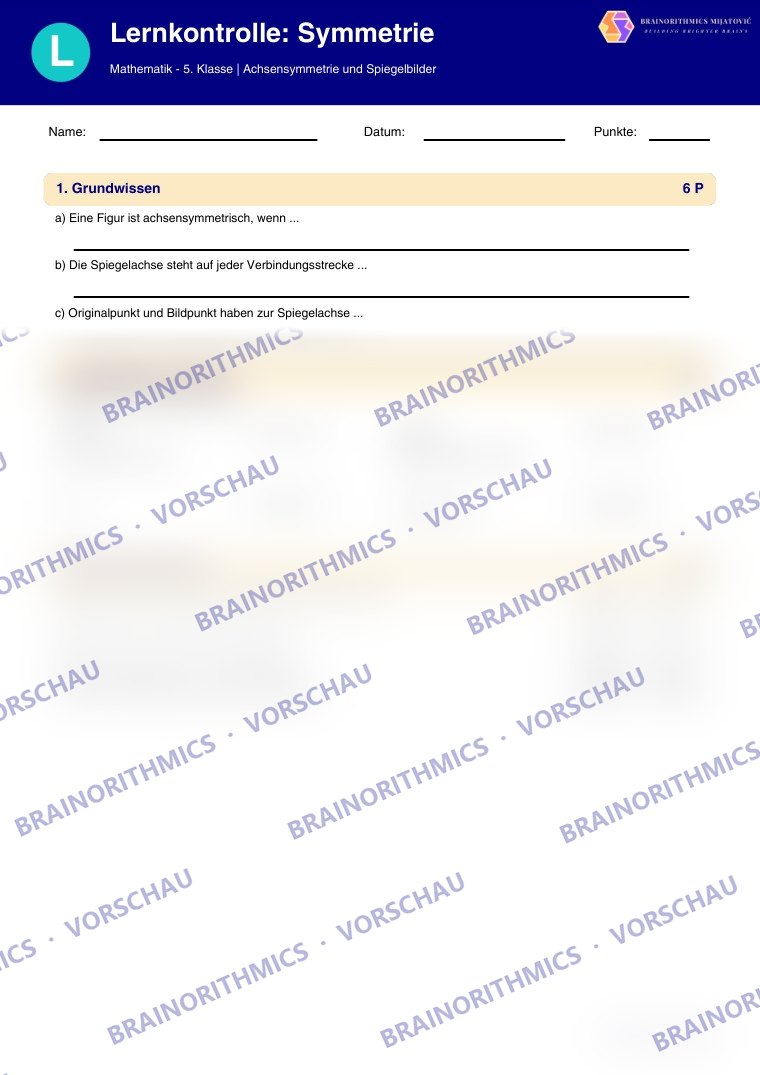
Two assessment pages on symmetry worth 30 points in total: explaining reflection symmetry in your own words, finding axes of symmetry, drawing mirror images on a grid, reflecting points using coordinates and one task on reasoning. With a self assessment at the end and two answer pages.
At a glance
Grade
grades 5 and 6
Subject and topic
Maths, Reflection symmetry and mirror images
Length
4 pages
Contents
Tasks with a separate answer sheet
Format
PDF to print
Delivery
Instant download and by e-mail
How to use the assessment
Ideally your child works through the sheet alone and calmly, just like a test at school. Afterwards you check it together using the answer sheet. More interesting than the score is which type of task is not yet secure.
The assessment works well as a check a few days before a test or after the holidays, to see what has stuck. If your child does the sheet again a few weeks later, you can see the progress in black and white.
Maths in grades 5 and 6
In grades 5 and 6 maths becomes more abstract. Fractions are at the centre: recognising and calculating parts, showing fractions with models and on the number line, mixed numbers and unit fractions. Decimals and percentages follow, as well as the order of operations with brackets, rounding and estimating with large numbers and, in geometry, reflection symmetry, reflecting in a coordinate grid, point and rotational symmetry.
The content follows the Swiss Lehrplan 21 curriculum. Exactly when a topic is covered depends on the canton, the school and the textbook.
11 pages of calculating, puzzling and revising: large numbers, written calculation, fractions, decimals, percentages, measures, areas and word problems. Ideal for 5th and 6th grade: the tasks refresh the basics and lead step by step to more demanding topics. With an answer section for self-correction.
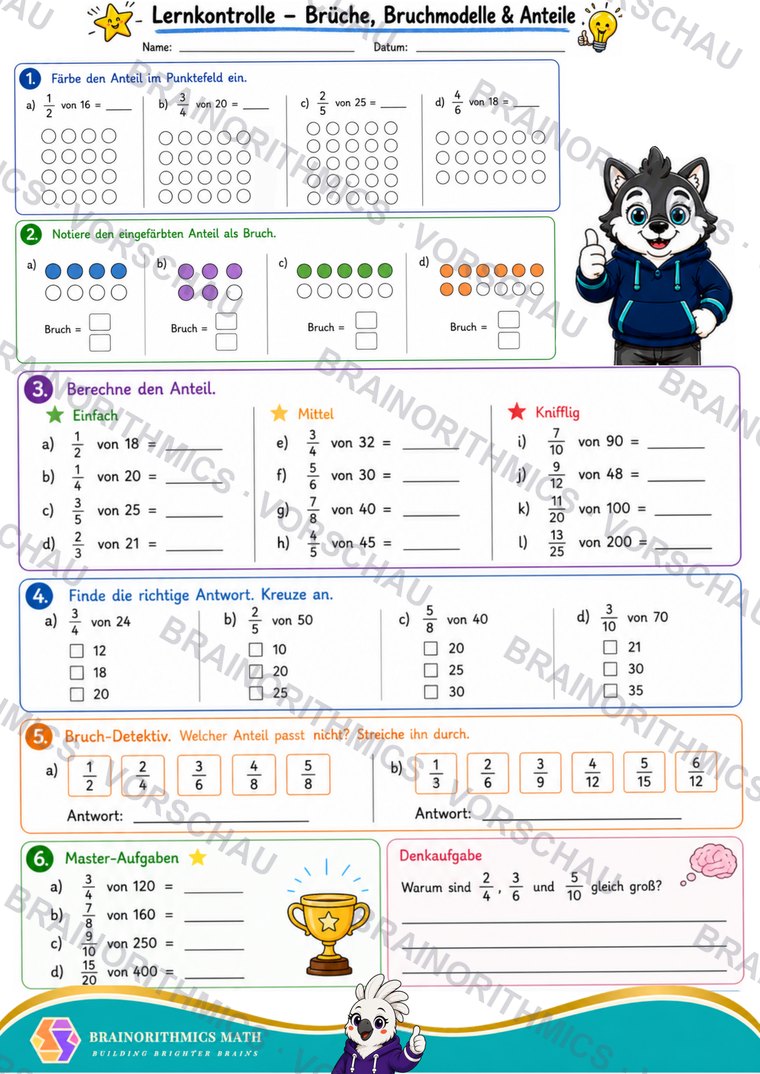
An assessment all about parts of a whole: colour in parts on a dot field, write them as a fraction, calculate parts (3 levels: easy, medium, tricky), multiple choice, fraction detective, master tasks and a thinking task. 41 points.
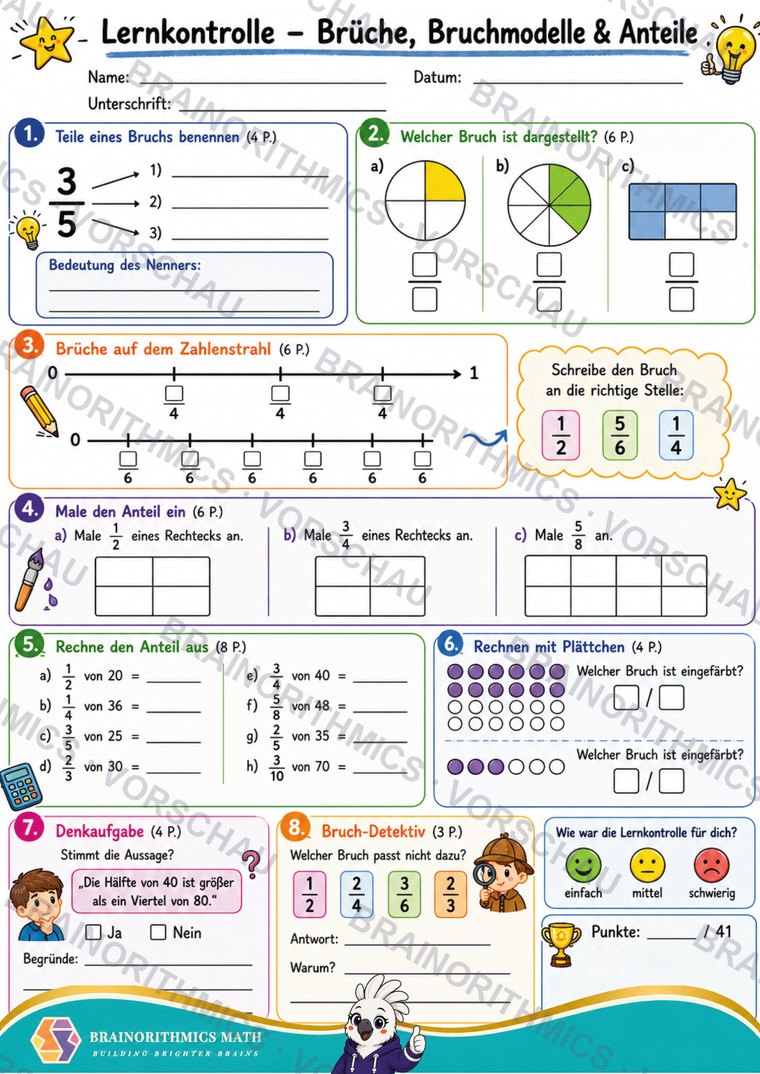
A comprehensive assessment: name the parts of a fraction, read fraction models, place fractions on the number line, colour in and calculate parts, work with counters, plus a thinking task and fraction detective. 41 points.