Mind map: Primes, divisors & multiples, grades 5 and 6
Mind map for grades 5 and 6: 2 pages as a PDF, CHF 4.
5th–6th gradePreview · Full PDF after purchase
What your child practises
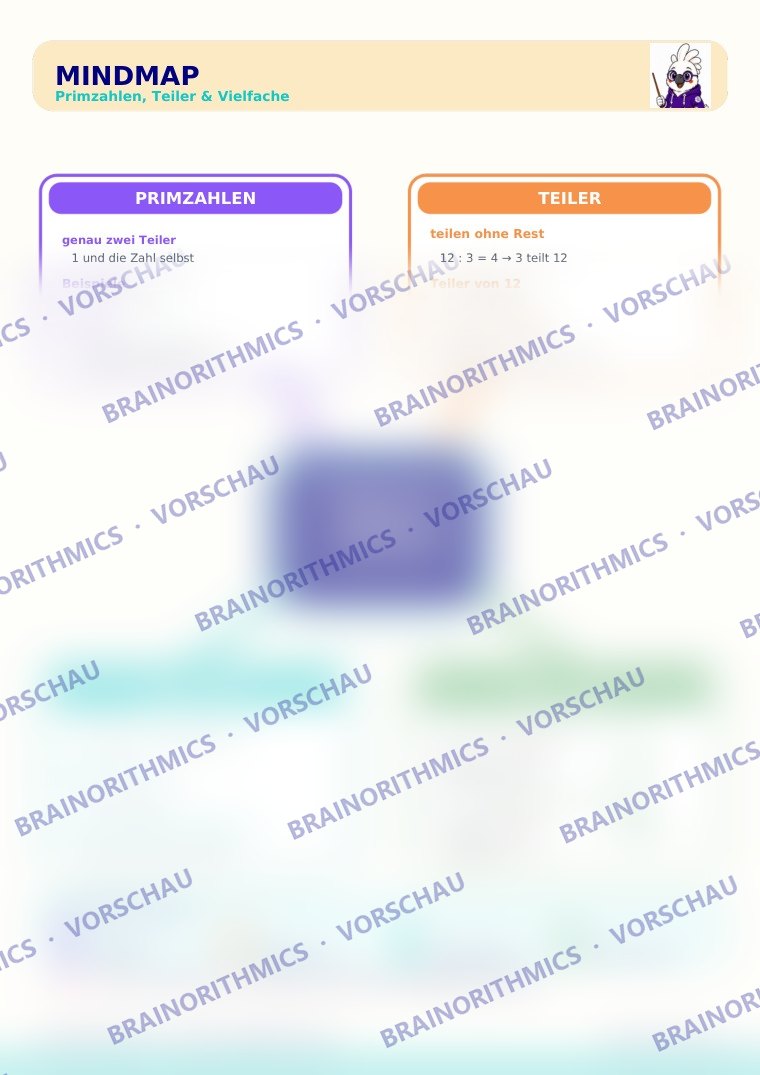
Two learning posters: the first shows prime numbers, divisors, multiples, HCF and LCM with examples and four steps to follow. The second sums up the divisibility rules for 2, 3, 4, 5, 8, 9, 10, 25, 100 and 125, with examples. To hang up or file away.
At a glance
Grade
grades 5 and 6
Subject and topic
Maths, Primes, divisors and divisibility rules
Length
2 pages
Contents
A4 learning poster
Format
PDF to print
Delivery
Instant download and by e-mail
How to use the mind map
The mind map sums up a whole topic at a glance. Hung above the desk or kept at the front of the folder, it helps when revising for a test and for looking things up during homework.
A good trick: your child explains one branch of the mind map to you in their own words. What they can explain, they have understood.
Maths in grades 5 and 6
In grades 5 and 6 maths becomes more abstract. Fractions are at the centre: recognising and calculating parts, showing fractions with models and on the number line, mixed numbers and unit fractions. Decimals and percentages follow, as well as the order of operations with brackets, rounding and estimating with large numbers and, in geometry, reflection symmetry, reflecting in a coordinate grid, point and rotational symmetry.
The content follows the Swiss Lehrplan 21 curriculum. Exactly when a topic is covered depends on the canton, the school and the textbook.
24 doors from 1 to 24 December: a budget for the winter stall, fractions in the biscuit tin, multiples, a discount on a sledge, the magic snow square, experiments such as the paper bridge, and logic with rotated patterns. With an answer section for self-correction.
24 doors from 1 to 24 December: thirds and quarters with parcels for three schools, a scale of 1 : 2,500, the winter timetable, decimals and inverse operations, common multiples, reflections in a coordinate grid and experiments on water displacement. With an answer section for self-correction.
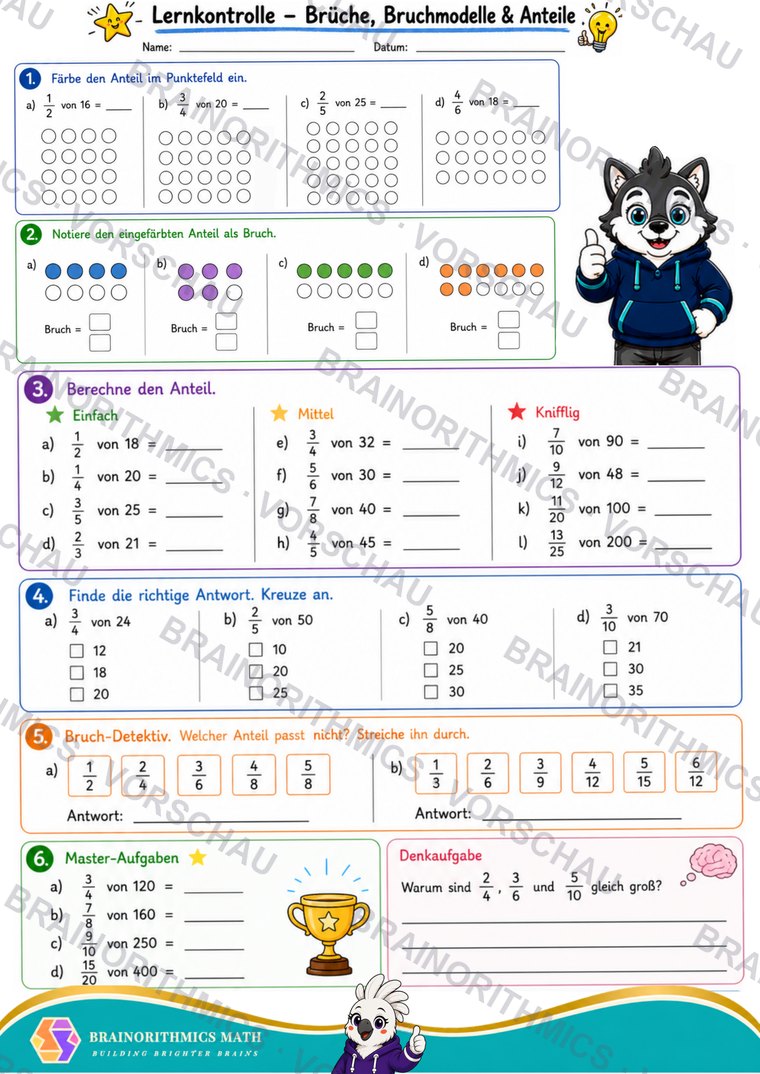
An assessment all about parts of a whole: colour in parts on a dot field, write them as a fraction, calculate parts (3 levels: easy, medium, tricky), multiple choice, fraction detective, master tasks and a thinking task. 41 points.