Parents who hear about our maths programme for the first time often ask: “Isn’t that just tutoring in a group?”
The question is fair. Both take place in the afternoon, both have to do with maths, and in both a child sits with a teacher working on tasks. The difference lies in what the lessons start from.
Classic tutoring: the school material sets the pace
Classic tutoring usually begins with the exercise book from school. What is coming up this week, which homework is still open, when is the next test? That is what gets worked on. This makes sense when a child needs help at short notice, and we offer exactly that too: tutoring, one to one, following the school’s teaching materials.
The limit of this approach: it reacts. It follows the next chapter and the next test. If a child in grade 5 struggles with fractions because division from grade 4 was never secure, pure homework help can work around the same gap week after week without closing it.
Our maths programme: the foundation sets the pace
The Brainorithmics Math Program was developed by our founder Nataša Mijatović. It combines proven international learning methods with the requirements of the Swiss curriculum, and it puts one question at the centre that often gets too little attention in everyday school life: does the child understand why something works, or have they only memorised the rule?
That is why our maths courses work independently of the current chapter at school. They follow five levels that build on each other, from the “Little Maths Heroes” aged 5 to 6 through “Calculating like a pro” aged 7 to 9 up to the “Masters of Number Logic” aged 11 to 12. For young people from age 11 there is also an upper school group. Your child starts where they currently stand.
At every level we work on the same four goals, just at a different level:
- Understanding: what does a number, a calculation or a relationship between numbers actually mean?
- Strategies: can I break a number down, complete it, estimate or use a pattern instead of calculating blindly?
- Applying: does my knowledge also help me with an unfamiliar word problem or in everyday life?
- Thinking: can I explain my solution and perhaps find a second way?
A child who masters these four things in a range of numbers copes with the next chapter at school, whatever order it comes in.
Five differences at a glance
- Starting point: tutoring starts with the current school material, the programme with your child’s level of learning.
- Time frame: tutoring is often planned for a few weeks, the programme for the whole school year and beyond.
- Format: at Brainorithmics tutoring usually takes place one to one in 60 minute lessons, the programme in groups of at most eight children, usually four to six, with 105 minute lessons.
- The role of mistakes: in homework help the result should be right in the end. In the programme a mistake is often the best starting point for a discussion in the group: where do our ways differ, and at which point did something happen?
- Motivation: puzzles, small competitions and mathematical games require the same skills as a worksheet, but here children want to keep thinking of their own accord.
Why the small group helps
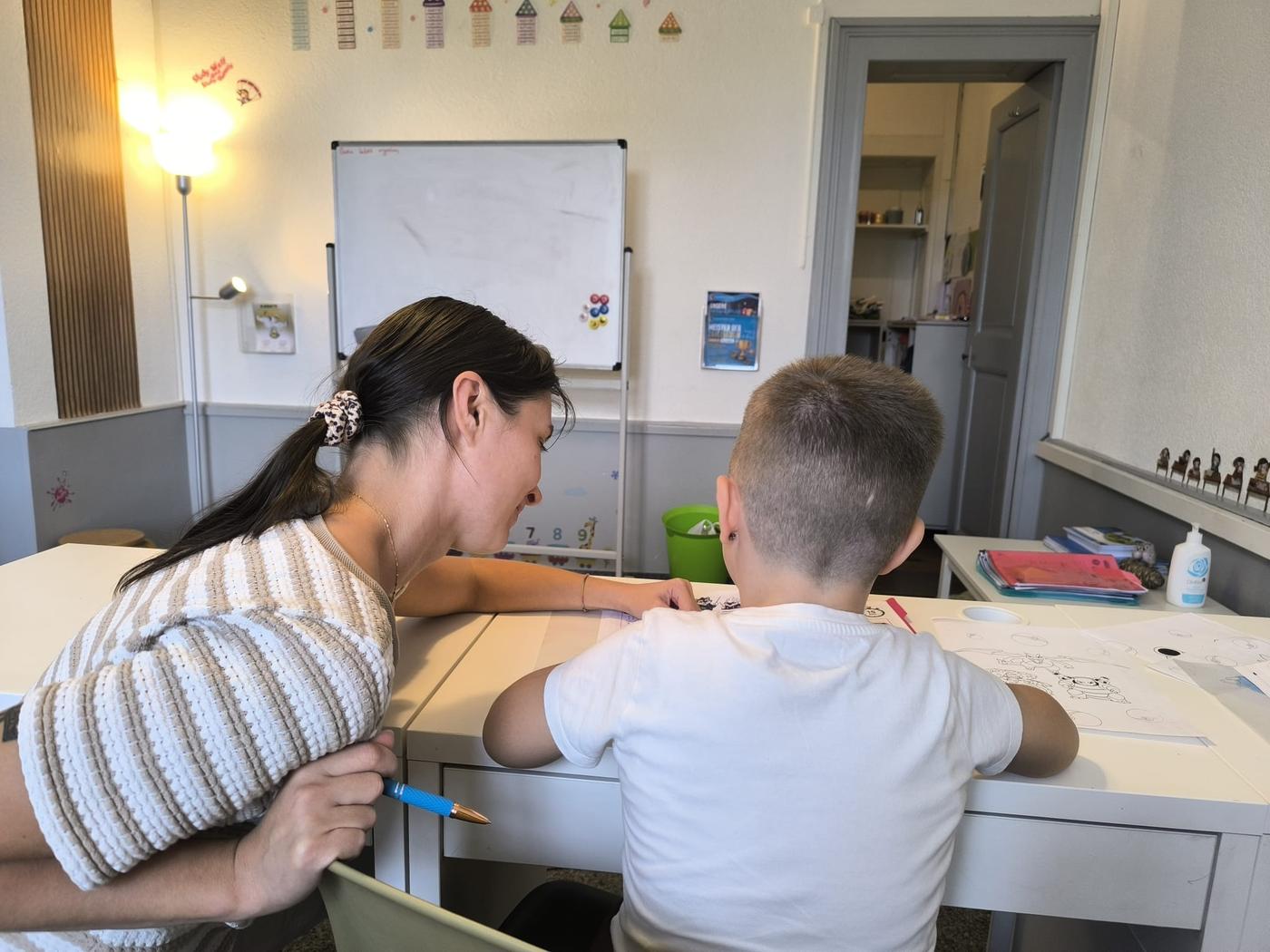
In a group of four to six children the teacher sees every solution and can support every child individually. At the same time the children experience that others think differently. A child who has to explain their way understands it better, and a child who hears a second way has two options next time.
Within the group every child works at their own level: those who are quicker get more challenging tasks, those who need more time look at a step more closely. Playful does not mean undemanding for us.
When is classic tutoring still the right choice?
The programme does not replace every kind of tutoring. If an exam is just around the corner, if it is about Gymnasium preparation in grades 5 and 6 or grade 9, or if a child needs help in German or English, one to one lessons are often the more direct route. Some children attend both for a while.
You will find a guide for your situation in the article A course or a few tutoring lessons. And a free trial lesson tells us the most: afterwards we can see where your child stands and tell you honestly which format makes sense.
Frequently asked questions
Does the programme follow the Swiss curriculum?
Yes. The Brainorithmics Math Program combines proven international learning methods with the requirements of the Swiss curriculum. It does not work through the school book chapter by chapter, though, but builds the foundations that every chapter assumes.
How can I tell whether my child needs the course or tutoring?
If it is about a particular exam or a single chapter, tutoring is usually the more direct route. If maths has been getting harder with every chapter for months, or if your child wants more than lessons at school offer, the course tends to fit better. In the free trial lesson we can see it more precisely.
Is the programme only for children who struggle?
No. Every child works at their own level, and those who are quicker get more challenging tasks. Many children do not come because of a gap but because they want to understand maths better or enjoy more puzzles.
What does the maths course cost?
From CHF 157.50 per month in a small group, including a small gift for your child. Siblings receive a discount, and the first trial lesson is free.