“Should my child practise maths in the holidays, or are holidays simply holidays?”
Many parents ask themselves this question. Children need time to rest, move, play freely and get away from everyday school life. At the same time, short and targeted revision can help to consolidate maths skills they have already learned.
What matters is not practising as much as possible, but finding the right balance between rest and learning.
Why a little maths during the holidays can make sense
Learning maths builds on knowledge and skills that have already been acquired. A good sense of numbers, secure basic operations and suitable calculation strategies are important foundations for everything that comes next.
Short revision can be especially useful for topics a child has only recently learned or still feels unsure about.
This is not about working ahead on new school material or solving as many tasks as possible. Rather, the holidays offer a chance to return to familiar topics in a more relaxed setting.
Not every child needs the same amount of practice. Some benefit from occasional revision, others above all need a deliberate break from school learning.
How much maths practice makes sense in the holidays?
Short practice sessions spread over several days can be more useful for consolidating what has been learned than one long afternoon of practice just before school starts.
The following times can serve as a rough, non binding guide:
| School level | Possible length of a practice session |
|---|---|
| Grades 1 and 2 | 5 to 10 minutes |
| Grades 3 and 4 | 10 to 15 minutes |
| Grades 5 and 6 | 15 to 20 minutes |
| Lower secondary | 15 to 25 minutes |
These times are not fixed rules. Age, concentration, learning level and individual needs all play an important role.
Not every child has to practise every day. Depending on need, a few short sessions a week can already make sense. Some families find a regular moment helpful, for example after breakfast.
On festive days, while travelling or simply on days when your child needs a break, maths can of course take a back seat.
The holidays should stay holidays.
Which maths topics are worth revising?
It makes most sense to build on your child’s current learning level. A look at the exercise book, the latest homework or an earlier test can give you a sense of direction.
Depending on the grade, the following topics can be suitable, for example:
| Grade | Possible topics to revise |
|---|---|
| Grade 1 | Quantities, number sense, splitting numbers, addition and subtraction |
| Grade 2 | Place value, addition and subtraction, first ideas of multiplication |
| Grade 3 | Times tables, division, number patterns and calculation strategies |
| Grade 4 | Larger numbers, basic operations, written and partly written methods, measures |
| Grade 5 | Fractions, decimals, basic operations and word problems |
| Grade 6 | Fractions, decimals, proportionality and applied maths |
This overview is meant as a guide. Which topics are really suitable depends on what has already been covered in class and where your child currently stands.
You will find more information in our article Maths in Lehrplan 21, from grade 1 to grade 6.
Understanding maths instead of just calculating faster
When practising maths, many people first think of mental arithmetic, the times tables or getting as many tasks right as possible.
A certain confidence and fluency in calculating is important. But maths covers a great deal more.
At Brainorithmics, we put particular emphasis on children understanding mathematical connections, getting to know different calculation strategies and developing their own ways of solving problems.
That is why simple questions can be valuable in the holidays too:
- How did you get this result?
- Why does your method work?
- Is there another way?
- Can you see a pattern or a connection?
- How could you check your result?
Sometimes a single task that a child thinks about carefully can be worth more than a whole page of sums solved mechanically.
Progress in maths shows not only in speed, but also in understanding, in independence and in choosing suitable strategies.
Maths in everyday life, without a worksheet
The holidays in particular offer many natural chances to discover maths.
| Activity | Discovering maths |
|---|---|
| Baking Christmas biscuits and cooking | Measuring quantities, doubling or halving recipes |
| Shopping | Comparing prices, working out amounts, estimating change |
| Board, card and dice games | Counting points, thinking logically, developing strategies |
| Crafts and wrapping presents | Discovering lengths, areas, geometric shapes and symmetry |
| Trips and travel | Working out times, journey times and distances |
| Building and construction | Spatial thinking, proportions and patterns |
Not every everyday situation has to be turned into a maths lesson. Interesting mathematical questions often come up all by themselves.
Maths can become visible where it happens anyway: in the middle of everyday life.
Maths puzzles in the Advent season
In the weeks before Christmas, small puzzles and thinking tasks can be a varied and playful way to discover maths.
From 1 December, children will find mathematical challenges and exciting tasks to puzzle over and think about in our free Brainorithmics Advent calendar.
The tasks can be explored alone or together with the family. Perhaps it will even become a small shared Advent ritual.
How can holiday maths practice work with as few arguments as possible?
A few simple approaches can make practising together more relaxed.
- Let your child have a say: if your child can choose between a puzzle, a game or a few calculations, they may feel more involved.
- Set small goals: a few selected tasks are often a better start than a whole page full of sums.
- Ask about the method: “How did you work it out?” often tells you more than simply checking the answer.
- Make progress visible: needing less help, a smarter method or a clearer explanation are also signs of progress in maths.
- Allow mistakes: mistakes are a chance to find out together where a misunderstanding lies or which strategy might work better.
- Stop in time: if practising leads to arguments or frustration, it is worth rethinking the task, the length or the time of day.
Sometimes a different explanation helps. And sometimes a break is the better decision.
Finding suitable maths practice for the holidays
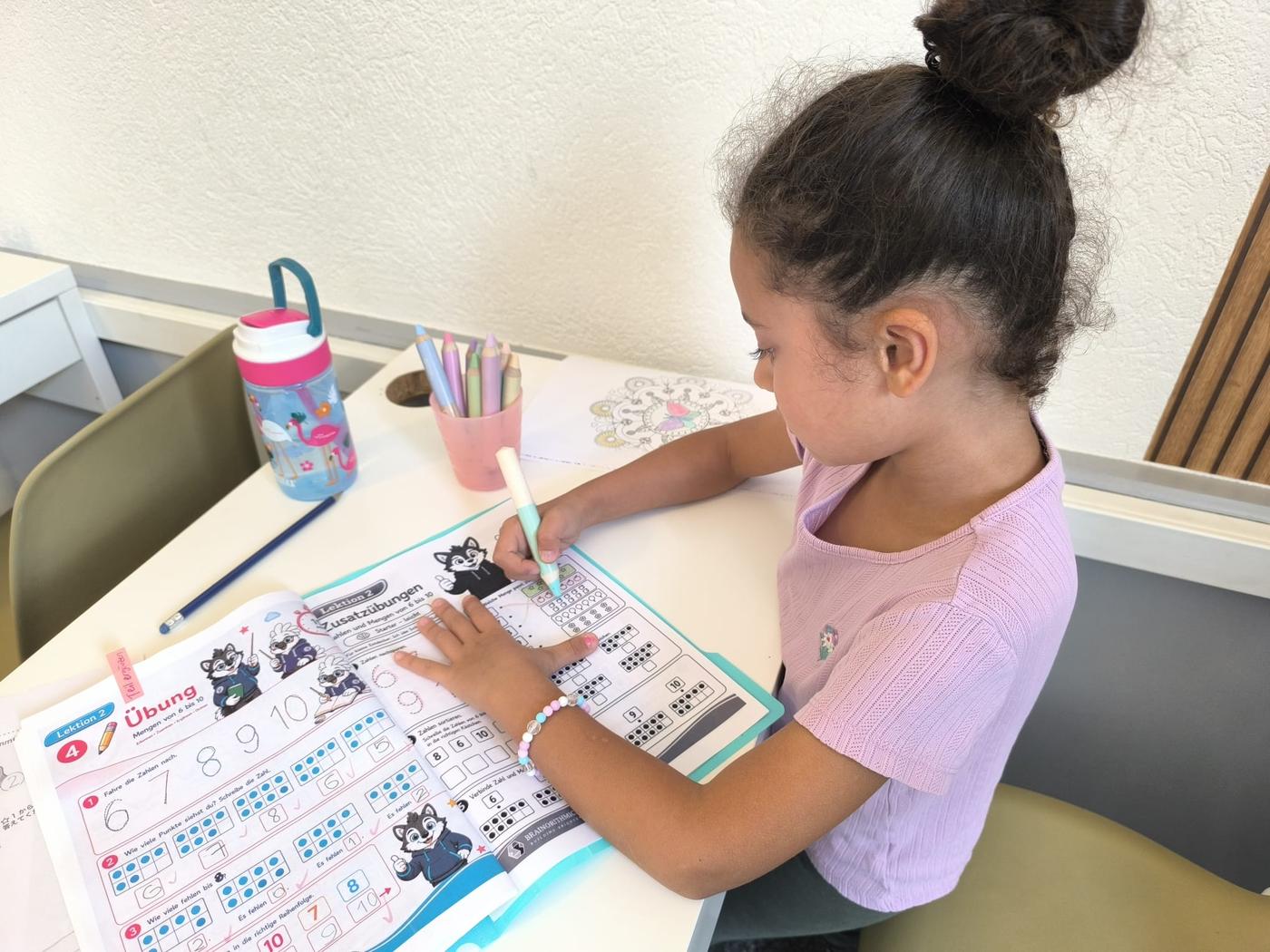
In our Brainorithmics learning world you will find a range of maths materials for use at home:
- Worksheets for targeted revision of individual topics.
- Workbooks for consolidating different topics in a varied way.
- Assessments for a snapshot of the current learning level.
- Puzzles for discovering mathematical connections and for logical thinking.
The materials are sorted by grade: grade 1, grade 2, grade 3, grade 4 and grades 5 and 6.
For the holidays, your child does not need to work through a whole workbook or a complete assessment. A few selected tasks that match their current level are often enough.
When practice reveals uncertainties in maths
Not every uncertainty automatically means there is a bigger gap in knowledge. Perhaps your child just needs a short reminder, a different explanation or a little more time.
But if difficulties with basic mathematical connections keep showing up, it can make sense to take a closer look.
At Brainorithmics we offer different kinds of support:
- Our tutoring is for children and young people with a specific need for support at school.
- Our maths programme focuses on systematically building mathematical understanding, suitable calculation strategies and logical thinking.
Which option fits your situation better is explained in our article A course or a few tutoring lessons?
Holidays can stay holidays
Children need time in which they do not constantly have to perform, achieve or improve something. They can play, move, be creative and sometimes simply do nothing at all.
If maths finds its place now and then, while baking, playing, puzzling or in a short practice session, that can be a lovely way to consolidate what has already been learned.
If you notice that your child needs more support with certain maths basics, we will gladly advise you on what we offer at our Brainorithmics locations in Aarau and Cham.
Contact us for personal advice.
Because the goal is not to do as much maths as possible in the holidays. The goal is to experience maths with understanding, curiosity and enjoyment, without cutting the rest short.
Frequently asked questions
Should my child practise maths in the holidays at all?
That depends on your child’s individual learning level and current situation. Short revision can make sense, especially for topics that are not yet secure. At the same time, rest, exercise and play have an important place in the holidays.
Does my child have to practise maths every day in the holidays?
No. Depending on need, a few short practice sessions a week can make sense. Longer breaks from learning are fine too.
How long should my child practise maths in the holidays?
For younger children, five to ten minutes can already be a suitable practice session. For older children, somewhat longer sessions can make sense. What matters is your child’s individual need and concentration.
Which maths topics should my child revise?
Topics that have already been covered but are still uncertain can be especially suitable. These include, for example, number sense, basic operations, times tables, calculation strategies, fractions or decimals.
Should my child already learn new school material in the holidays?
In many cases it makes more sense to consolidate basics that have already been covered. But if a child wants to explore a new maths topic out of their own curiosity, there should of course be room for that too.
How can my child practise maths in a playful way?
When baking, shopping, building, doing crafts or playing, children come across numbers, quantities, shapes, patterns and mathematical connections. Riddles, logic games and puzzles can also be a varied alternative to classic worksheets.
What if my child does not feel like doing maths in the holidays?
Perhaps your child needs a break or finds the tasks too difficult or monotonous. Try a different activity or shorter practice sessions. If practising keeps leading to conflict, maths can take a break for a while.
Do assessments make sense in the holidays?
Assessments can help to gauge individual maths skills. However, they do not have to be completed in full or under test conditions. A few selected tasks can also be revealing.
Where can I find suitable maths practice for the holidays?
In the Brainorithmics learning world you will find worksheets, workbooks and assessments for different grades and topics.
Can my child also use the Brainorithmics Advent calendar during the holidays?
Our Brainorithmics Advent calendar offers maths puzzles and thinking tasks during Advent. Information on when the doors open and on availability after Christmas can be found directly on the Advent calendar.