When parents hear about a coding course for children for the first time, almost the same question always comes up: «Does my child really have to become a computer scientist later on?»
The answer is a clear no.
The vast majority of children who build their first game at Brainorithmics will not become software developers. That was never the actual goal.
For us, coding is a tool. A tool children use to train abilities that reach far beyond the computer: thinking logically, recognising patterns, structuring problems, developing their own solutions and carrying on even when something does not work straight away.
Breaking a large, initially confusing problem into small, solvable steps is a skill children need in many areas. A child who can do that will find it easier to work through a word problem in maths, to structure an essay, to run a science experiment or to plan a presentation.
That is exactly why coding belongs to modern education, in our view.
In this article we show what children actually learn in our coding courses, how their learning path can develop, and how parents can tell whether coding suits their child.
Coding is a way of thinking, not a technique
Educational research has its own term for this: computational thinking, in other words algorithmic thinking.
It does not refer to a particular piece of software or a particular device, but to a way of approaching problems. In doing so, children practise four basic mental moves again and again.
Breaking things down
A child wants to build a game in which a character collects coins.
At first this sounds like a single task, but it consists of many smaller ones. The character has to move. The coin has to appear somewhere. The program has to notice when the two touch. It has to count, display the score and decide when the game is over.
This very ability, taking a big problem apart into smaller, manageable tasks, is an important part of coding.
Recognising patterns
A child who has programmed three opponents may notice with the fourth that a lot of it repeats.
Children discover that they do not have to write the same sequence from scratch every time. They start to see similarities and recurring structures.
That is a first step towards what computer science calls abstraction.
Telling the essential from the incidental
For the basic function of a game, it does not really matter at first what colour a coin is. What matters is the function it serves.
Being able to distinguish important information from less important information is a demanding mental task, and coding trains it constantly, almost as a matter of course.
Thinking in sequences and conditions
What happens first? What comes next? And what happens if a particular condition is not met?
A computer carries out instructions exactly as they were written. Children therefore experience very directly why order, precision and clear instructions matter.
These thought processes are the real subject matter for us.
The programming language is simply the tool children use to make that thinking visible.
What children really take away from a coding course
Persistence instead of perfection
Almost no program works on the first attempt.
That is not a drawback. Quite the opposite: this is often where the most interesting part of the learning begins.
Children experience that a mistake does not mean they have failed. Rather, it shows them that something does not yet work the way they planned.
They search, they try things, they change one small detail, and suddenly it runs.
At school a mistake is usually corrected. In coding it becomes information.
Professionals call the search for a fault in a program debugging. But there is more behind it than a technical term. Children learn to work systematically:
- What already works?
- Where does the problem start?
- What did I change?
- What happens if I solve this part differently?
This way of thinking can also help them approach maths tasks and other problems in a more structured way.
Visible results
One great advantage of coding is that children can see straight away what they have created.
At the end of a lesson there is something they can show: a game, an animation, a short story or a digital world they designed themselves.
Many children want to demonstrate their project at home right away.
That feeling, «I made this myself», can be a very powerful engine for further learning.
This is why it matters to us that children do not simply copy a template. There is a shared framework and there are learning goals, but within that framework their own ideas should be able to grow.
Digital confidence
Children today grow up with digital devices as a matter of course.
So the decisive question is not only how much digital media they use, but also how they deal with it.
Are they purely consumers? Or do they increasingly understand that digital applications are built by people and follow certain rules?
A child who has coded something begins to see digital systems differently.
A game does not simply work «somehow». Someone set the rules. An app responds to certain inputs because it was built that way. Recommendations arise from data, models and decisions.
In the age of artificial intelligence, that understanding is becoming more and more important.
Children should not regard digital technology as magic. They should learn to ask, with curiosity: how does this actually work?
Focus and self organisation
Developing a project across several lessons calls for patience and planning.
That is why we work in manageable stages and with visible interim results. The child experiences progress step by step.
In this way coding can pass on more than technical knowledge. It can also build concentration, self organisation and independent work.
Language and working together
Coding is by no means a solitary activity.
A child who wants to explain why their game works the way it does has to structure their thoughts and put them into words others understand.
In our groups children show each other their projects, exchange ideas and help each other track down mistakes.
That is not an accidental side effect. It is an important part of the learning.
For us, maths and coding belong together
At Brainorithmics we do not treat maths and coding as separate worlds.
Both are about recognising patterns, structuring problems, understanding how things connect, developing your own path to a solution and learning from mistakes.
Our goal is therefore not to teach children as many programming languages as possible as early as possible.
What we want to show them is how to think when the solution is not yet in front of you.
A child should learn to look at a challenge and consider: what do I already know? What do I need to find out? How can I break the problem down? Which approach could I try? And what can I change if my first attempt does not work?
This way of thinking connects our maths and coding programmes and is part of our educational philosophy at Brainorithmics.
The learning path at Brainorithmics
We start where the child actually is, not simply where a particular age or school year would suggest.
Age recommendations are therefore a guide. Previous experience, interest and individual development matter just as much.
Coding Knight, a playful start for the youngest
This is about sequences, directions and simple commands, in part still entirely without typing.
Children discover through play that they can give a character instructions, and that the order of those instructions matters.
Digital Literacy, safe in the digital world
Before children build more complex programs, they need basic digital skills.
These include handling files and folders, basic computer skills, searching the internet, passwords and a responsible approach to digital media.
This area is often underestimated, yet it forms an important foundation for all further digital learning.
Visual programming with Scratch
With coloured programming blocks, children can get to know fundamental coding concepts without typing errors or syntax getting in the way.
Loops, conditions, variables and events become visible and immediately tangible.
Scratch is therefore one of the most proven ways to introduce children to core coding concepts.
Minecraft
A familiar digital world can become a place to learn.
Children build their own worlds and challenges, and in doing so experience how planning, logic and structured sequences work together.
For many children it is precisely the link between a game they know and actively creating something that makes it so motivating.
Game Design
From the idea to the finished level, this is not only about coding but also about design and user experience.
What makes a game interesting? When is a task too hard? When does it become boring? What rules does a good game need?
Children test each other's projects and learn to take feedback on board and develop their own ideas further.
Python
With growing experience, the step from visual coding to text based programming can follow.
Python is a widely used programming language, applied both in education and professionally across many fields.
Young people can use it to realise their own projects and increasingly learn to plan, write and improve programs independently.
Artificial intelligence
How does a computer learn? What is training data? What is a prediction? And why can artificial intelligence get things wrong?
Children and teenagers should not only use artificial intelligence, but understand the basic principles behind it.
Small projects of their own help to make abstract terms visible and understandable.
For our coding courses we draw on structured teaching concepts and curricula from the Algorithmics environment, and combine them with the personal support and educational philosophy of Brainorithmics.
Why small groups matter so much
You do not learn to code by listening alone.
Above all, you learn it by building something yourself, trying it out, getting stuck on a problem and looking for another way.
It is exactly at that moment that a child needs a teacher who does not simply give the answer, but asks the right question.
- What have you tried so far?
- What already works?
- At which point does the result change?
That is why we deliberately teach in small groups.
Every child should be able to get feedback on their own work. Those who move faster can extend their project. Those who need more time get the chance to look at a step in more detail.
On request, lessons can be held in German or in English. For some families it is precisely this combination that appeals: the child works on a topic they find exciting and at the same time meets English terms and phrasings that play an important role in computing anyway.
What coding has to do with school subjects
The benefit of coding does not end at the computer.
Maths
An abstract variable can become the score in your own game.
Coordinates suddenly determine where a character stands on the screen. Numbers and arithmetic take on a concrete function.
Mathematical ideas can be experienced in a new context.
Language
Coding calls on a similar ability to writing: think first, then structure, then put it into practice.
A child who is used to breaking a plan into individual steps can apply the same strategy when planning a text or a presentation.
There is also the explaining: a child who wants the group to understand how their game works is practising how to express thoughts clearly.
Science
Here too the parallels are clear.
Form a hypothesis, try it out, observe the result and adjust the original assumption. Children meet this approach in science just as they do in coding.
And across all of these areas there is one important experience: sticking with something can pay off.
How a lesson runs
We begin with a short round together. What did we do last time? Where are the projects? What is new today?
Then comes a compact input in which a new concept is shown using a concrete example.
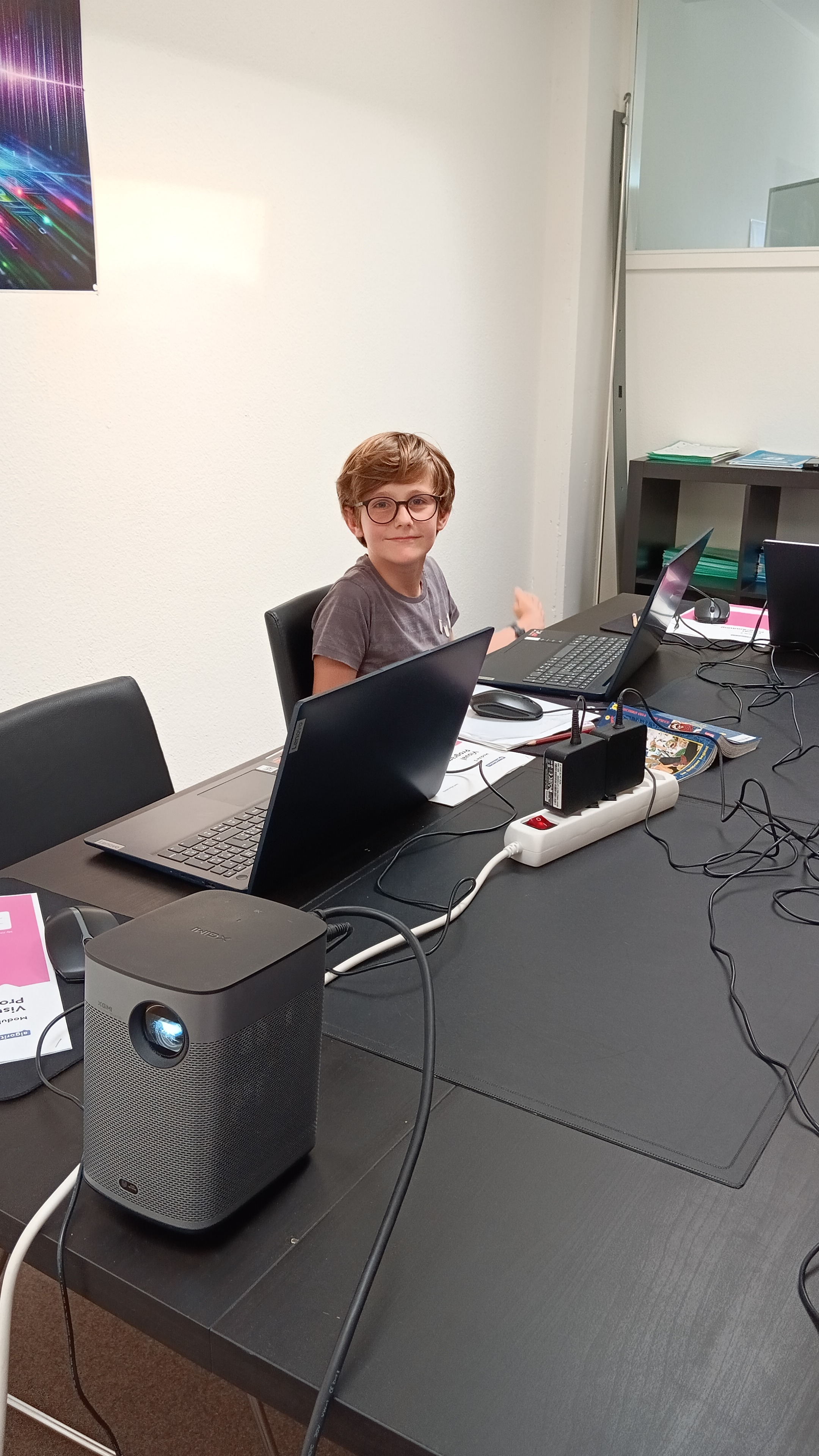
Most of the time then belongs to the children's own work.
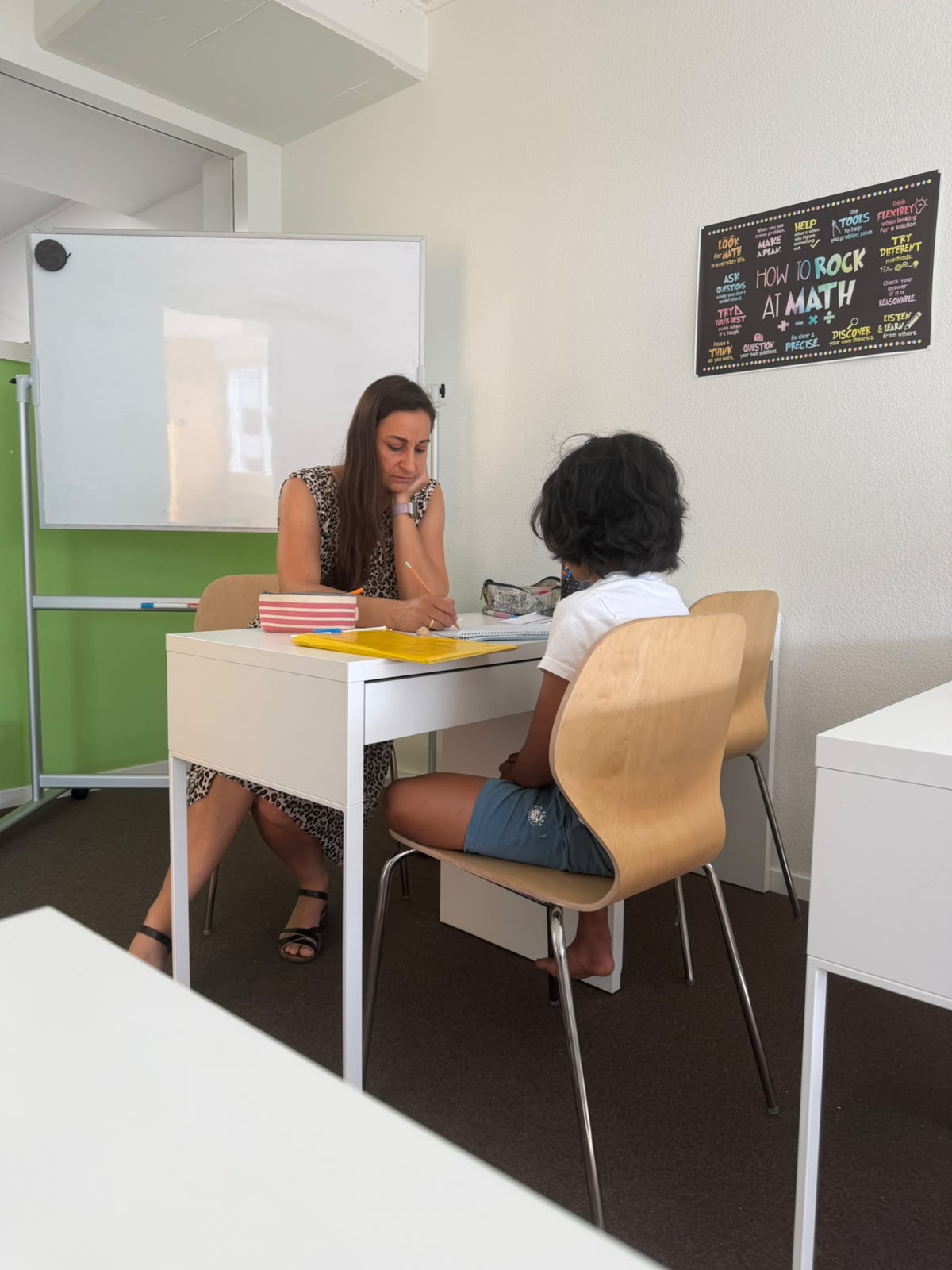
The teacher accompanies them, looks over their shoulder, asks questions and steps in where a child cannot get any further alone, without needlessly taking the solution off their hands.
At the end the children show each other what they have achieved.
Those last few minutes matter to us.
Explaining regularly what you have built means engaging consciously with your own learning once more. At the same time children experience that their ideas are seen and valued.
From what age is coding suitable?
A playful start is possible as early as kindergarten or the first years of primary school.
Which course and which learning environment fit, however, does not depend on age alone.
Previous knowledge is usually not necessary to get started.
Good signs are often quite everyday ones. Your child likes to build things and comes up with their own solutions along the way. They want to know how things work. They develop their own ideas. They may enjoy digital games and think about what they would change in them. Or they can stay with one thing for a longer stretch when it really interests them.
For a first attempt, nothing more than that is needed.
And a child certainly does not have to be particularly good at maths in order to learn to code.
Coding can instead open up a new way into mathematical and logical thinking, because numbers, coordinates, variables and rules suddenly take on a concrete function.
And what about screen time?
Parents are quite right to ask us this.
Yes, when coding, a child is also working in front of a screen.
The decisive difference lies in what they are doing there.
With passive consumption, the device largely sets the pace and the child reacts.
In coding that relationship is reversed. The child gives the instructions and the computer responds.
These are two very different forms of media use, even if they can look similar from the outside.
What is more, not all of the learning time has to happen at the device. Planning, sketching, explaining, discussing and working out solutions together are all part of coding.
If you have screen time rules at home, it can therefore be worth talking with your child about the difference between active and passive media use.
What parents can do at home
You do not need to be able to code yourself.
You do not need to know any technical terms either.
Something very simple is often far more valuable: let your child show you what they have built.
Ask:
- How did you do that?
- What was difficult?
- What did not work at first?
- What would you like to add next?
Try not to offer a solution straight away.
When a child is working on a mistake, an important learning process is taking place right there.
Comparisons with other children are not much help either. Coding is not a race. Speed says nothing automatic about how well a child has understood a concept.
If your child wants to keep building between lessons of their own accord, that is lovely of course. It should not be a requirement for taking part successfully, though.
Aarau, Cham or online
Our coding courses take place at our locations in Aarau and Cham, and depending on the offer also online.
Lessons on site suit younger children particularly well, and children who value direct exchange within the group.
Online lessons, on the other hand, can be interesting for families who live further away or who need more flexibility.
Whichever format you choose, active learning is at the centre of what we do.
Frequently asked questions
Does my child need their own computer?
For lessons on site, the devices needed are provided. For online lessons, depending on the course, a suitable computer or laptop with a stable internet connection is required. For more advanced coding courses, a proper keyboard is recommended.
My child plays a lot on the computer. Does a coding course still make sense?
Children who are interested in computer games are often especially curious about how a game actually comes about. A coding course lets them switch perspective, from consuming to creating. Instead of only playing, they develop rules, characters, sequences and ideas of their own.
What if my child loses motivation after a few weeks?
Talk to us. Sometimes it is down to a task that is too easy or too demanding, sometimes to a project that does not match the child’s interests. In small groups we can respond to differences like these and work out together what will help.
Is coding more of a boys’ thing?
No. Coding has no gender. What matters is curiosity, interest and the joy of building something yourself. Girls and boys learn together with us and bring very different ideas and interests with them.
How long does it take before my child can code something of their own?
Depending on the course and age, small visible results can already come out of a first lesson. A solid understanding of the underlying concepts, on the other hand, grows step by step over a longer period. It matters more to us that a child understands why something works than that they finish as many projects as quickly as possible.
What does a course cost?
Prices depend on the course, the format and the scope. Get in touch with your child’s age and your preferred location and we will tell you which offers and conditions currently fit.
Can school classes or groups book as well?
Yes. For school classes, groups, workshops and children’s birthdays we can put together dedicated formats depending on the offer. Get in touch with your group size and what you have in mind.
Is coding also suitable for children who find longer periods of concentration difficult?
It can work very well. Immediate feedback, manageable tasks, projects of their own and visible results make this way of learning especially motivating for some children. As every child is different, we suggest getting in touch beforehand so we can judge together which course and which learning environment might fit.