When parents think about tutoring for the first time, quite a lot has often already been tried at home.
A parent practises along at the kitchen table in the evening. A sibling explains a task once more. An extra exercise book is bought. Before an exam, everyone studies particularly hard.
And still, sometimes little changes. Or practising together becomes increasingly exhausting, because nobody knows exactly any more: is the understanding genuinely missing? Is a foundation shaky? Is it the learning method? Or has the situation simply become bound up with too much frustration?
Tutoring can then be a sensible form of support. In our view, though, what matters is not adding as much extra practice as quickly as possible. What matters is finding out where the difficulty actually lies and what support the child needs.
Because a poor grade is first of all a result, not a diagnosis.
This article is meant to help parents judge when tutoring can make sense, how to recognise good learning support, what role learning strategies play and how we work with children and young people at Brainorithmics.
The moment parents start thinking about tutoring
There is usually a specific trigger. A report card turns out worse than expected. An uncertainty comes up at the parents meeting. An important exam is coming. Or homework at home leads to frustration more and more often.
The understandable first thought is then often: we have to practise more.
Sometimes that is exactly right. But more is not always the answer.
Sometimes a child first needs a different explanation. Sometimes a foundation from an earlier topic is missing. Sometimes a lot of studying happens, but with a learning strategy that contributes little to independent recall. And sometimes a child understands the material in principle but cannot use that knowledge reliably in an exam situation.
That is why good tutoring begins for us with one question: what is actually causing this?
First understand where the difficulty lies
In our work we meet different starting situations. They can occur on their own or overlap with each other.
A gap in knowledge
A topic from an earlier school year is not secure, and new material builds on exactly that. This often shows up particularly clearly in maths, because many contents build on one another.
A child who is still very unsure of times tables, for example, can later run into difficulties with fractions, division or other topics, even though the current topic could in principle be understood.
Simply doing more exercises from the current chapter does not necessarily help then. Sometimes it makes more sense to go back a step and secure exactly the foundation that is needed for the next one.
At first that can look like a detour. Often, though, it is precisely the route that makes further learning understandable again.
The learning strategy does not fit yet
Some children invest a lot of time and are still disappointed by the result. They read a text several times, highlight important passages or look at their notes again and again. That quickly creates the feeling: «I know this.»
But recognising something is not the same as being able to explain it without notes or apply it in a new task.
For hard working pupils in particular that can be frustrating. What is needed then may not be more study time, but a different way of studying.
The exam situation
At home a task works, in the exam suddenly it does not. There can be different reasons for that.
Time pressure, nervousness, unfamiliar question formats or missing exam strategies can all play a part. At the same time, gaps in the subject itself can become visible only under exam conditions.
That is why we do not only look at whether a child knows the material, but also at how reliably it can apply that material independently. Exam preparation can therefore also include working under more realistic conditions and developing strategies for dealing with difficult questions.
Concentration and working method
Sometimes a child knows the route to the solution but loses the thread along the way. A question is only half read. A sign is overlooked. An intermediate step is missing. A number is copied incorrectly.
More material does not necessarily need explaining then. It can be more helpful to work on the method itself: how do I read a question carefully? Which intermediate steps should I write down? How do I check my result?
Strategies like these can be learned and trained too.
Understanding the language
Sometimes the difficulty lies not only in subject knowledge but in understanding the question. That can become visible particularly with complex word problems or exam questions.
A child may understand the mathematical idea but not recognise exactly what the question is asking for. That can affect children who are still learning German, but equally children who speak German well and struggle with complex question wording.
That is why at Brainorithmics we are not only interested in whether the answer is right or wrong, but also in how the child arrived at that answer.
The way of thinking and working can give important clues about where support can sensibly begin.
When tutoring is not automatically the right answer
For us, responsible learning support also means speaking openly about when additional subject lessons may not be the right instrument.
When the weekly schedule is already very full
School, homework, sport, music school, leisure activities and tutoring on top of that. More appointments do not automatically mean more learning success.
Children also need time for rest, movement, family and free time. Sometimes the question should therefore not only be «what else can we add?», but also «where might the child need relief?»
When the cause may lie outside the school material
Difficulties at school can have different causes. Stressful situations at school or at home, lack of sleep or ongoing overload can also affect concentration, motivation and school performance.
In situations like these, additional tutoring alone may not be enough. Depending on the starting point, a conversation with the school or with a suitable specialist can make sense.
When only the parents see a goal
Of course parents help decide what support their child receives. Even so, it helps when the child also understands why it is coming to tutoring.
Instead of only saying «your grade has to get better», a concrete goal can be more helpful: «I want to finally understand word problems better.» «I want to know how to start in an exam.» «I want to be able to do my homework more independently.»
A goal like that is more tangible for a child.
When what is really needed is homework supervision
Tutoring and homework supervision can overlap, but they do not have the same goal. If what is mainly needed is someone who makes sure the daily tasks get done, homework supervision can be the more suitable format.
Tutoring should go beyond that. It should start where understanding, subject knowledge, learning strategies or independent working need support.
When a professional assessment might make sense
With persistent or clearly pronounced difficulties in reading, writing, arithmetic, attention or other areas, a professional assessment can make sense.
Brainorithmics does not replace medical, psychological, school psychological or therapeutic assessment and treatment. Depending on the situation, we can support children additionally with their school learning.
For us, serious advice therefore also means saying openly when we have the impression that a different offer or a professional assessment would make more sense.
How parents can recognise good tutoring
The tutoring market is large and many offers sound similar at first. A few points can help with the choice.
Understanding comes first, teaching second
Before a sensible learning path can emerge, some things should become clearer: what already works? Where do difficulties arise? How does the child work? What is the concrete goal?
Only after that can it be decided sensibly what should be worked on.
There is a concrete goal
«Better grades» is an understandable wish. As a learning goal, though, it is very general. More concrete would be, for example:
- Understanding fractions and applying them reliably.
- Structuring word problems independently.
- Building an essay sensibly.
- Using vocabulary and grammar in your own sentences.
- Preparing for an exam in a structured way.
The clearer the goal, the better you can observe what progress is being made.
The child works itself
A good explanation is important. But learning does not come from listening alone. The child has to calculate, write, speak, explain, try things out, compare and be allowed to make mistakes itself.
The teacher accompanies this process, asks questions, gives impulses and helps where support is needed.
The aim is not to solve as many tasks as possible for the child. The aim is that the child increasingly knows how to proceed on its own.
Foundations are not ignored
Tomorrow's homework can be important. But if an older gap in knowledge lies underneath it, that gap should not be passed over permanently.
Good tutoring therefore connects the current school material with the foundations it requires.
Feedback is concrete
Parents should not only hear «it is going well». Concrete information is more helpful: what has been worked on? What is already more secure? Where is there still uncertainty? What is the next step?
Independence remains the goal
One of the most important points for us: tutoring should not make a child permanently dependent on support. The aim should be that it can increasingly work independently and deal with difficulties on its own.
«I can only do this if someone helps me» should step by step become: «I know how to start.» «I can look for my mistake.» «I know a strategy that could help me.»
Good tutoring should therefore make more independence possible in the long run.
The relationship with the teacher fits
A child has to be able to ask questions. It has to be allowed to show a mistake. And it should be able to say: «I do not understand this yet.»
That requires trust. It does not mean that every tutoring lesson always has to be fun. But a child should feel taken seriously and safe enough to show uncertainty too.
Individual tutoring or a small group?
Both formats can make sense. Which one fits better depends on the child, the subject, the learning goal and the particular starting point.
Individual tutoring
Individual lessons can be especially useful when very specific difficulties are to be worked on, when intensive exam preparation is coming up or when a child needs a lot of individual guidance.
Pace, tasks and explanations can be adapted very precisely to the individual child.
Small group
A small group offers different advantages. Children can get to know different routes to a solution, learn from each other and experience that others ask questions and make mistakes too.
Explaining your own route can also help to order your thoughts and deepen understanding. For some children the social element is motivating as well.
At Brainorithmics we therefore do not decide in principle that individual lessons are better or that a small group is better. We look at which format suits the child and the particular goal.
Our tutoring subjects
We support pupils in various school subjects. Children and young people come to us for maths particularly often. Depending on demand, we also offer support in German, English and further subjects.
Maths
Maths is the subject we support most often in tutoring. That is hardly surprising: many mathematical topics build directly on one another. An uncertainty from an earlier topic can therefore keep becoming visible later on.
For that reason we do not work exclusively on the current school chapter. Where necessary, we go back to the foundations that the current topic requires.
Depending on the school level it can be about basic arithmetic, times tables, fractions and decimals, percentages, geometry, algebra or word problems.
It is particularly important to us that children do not just apply calculation routes by heart. As far as possible they should understand: why does this route work? Which strategy can I use? Is there another way to the solution? How do I recognise which method fits a task?
If a child develops a liking for maths beyond targeted tutoring and would like to keep working systematically, our maths programme or other mathematical offers at Brainorithmics can also be interesting.
German
In German, support can look very different from child to child. Possible topics are spelling, grammar, reading comprehension, writing or text structure.
Rules can matter here. What is decisive, though, is that a child can also apply them.
When writing an essay we therefore do not begin only with individual formulations. First a text needs an idea and a structure you can follow: what do I want to say? How do I order my thoughts? What belongs in the introduction, the main part and the conclusion?
With reading comprehension it is in turn about reading questions carefully, recognising the relevant information and justifying answers in a way others can follow.
English
When learning English, vocabulary, grammar, reading and listening comprehension, writing and speaking belong together. Depending on the learning goal, different areas can be in the foreground.
Vocabulary, for instance, can be learned not only as individual words but also applied in sentences and concrete contexts. Grammar, in turn, should not only be known as a rule but be usable in writing and speaking.
Which priorities make sense depends on where the child stands and what the school currently requires.
Further subjects
Depending on the subject, school level, question and available teachers, support in further school subjects can also be possible. It is best if we clarify individually what support is being sought and whether we have the right offer for it.
How a tutoring lesson at Brainorithmics can run
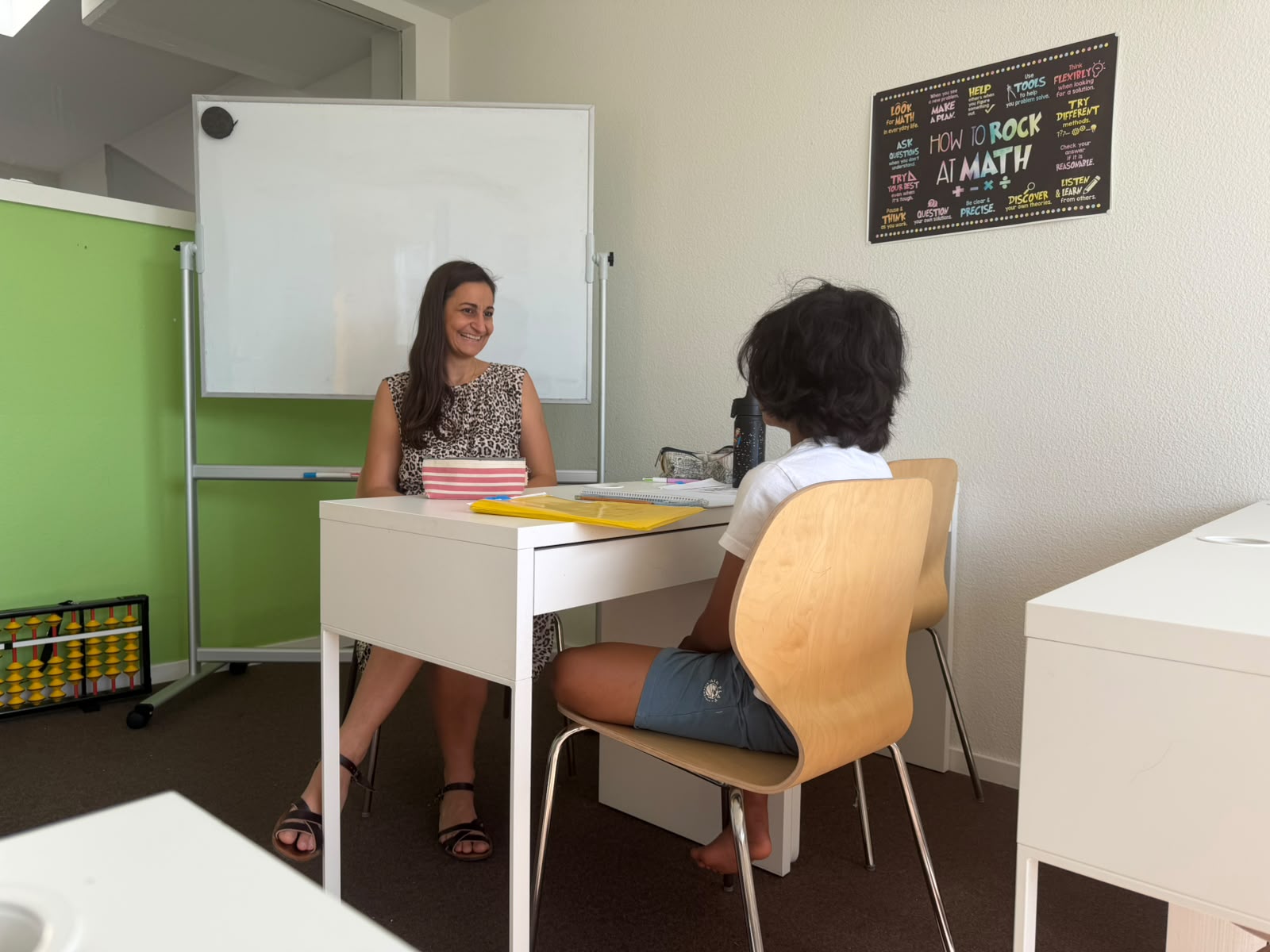
At the start we look back briefly. What has happened since the last lesson? Was there an exam? What worked well? Where were there difficulties?
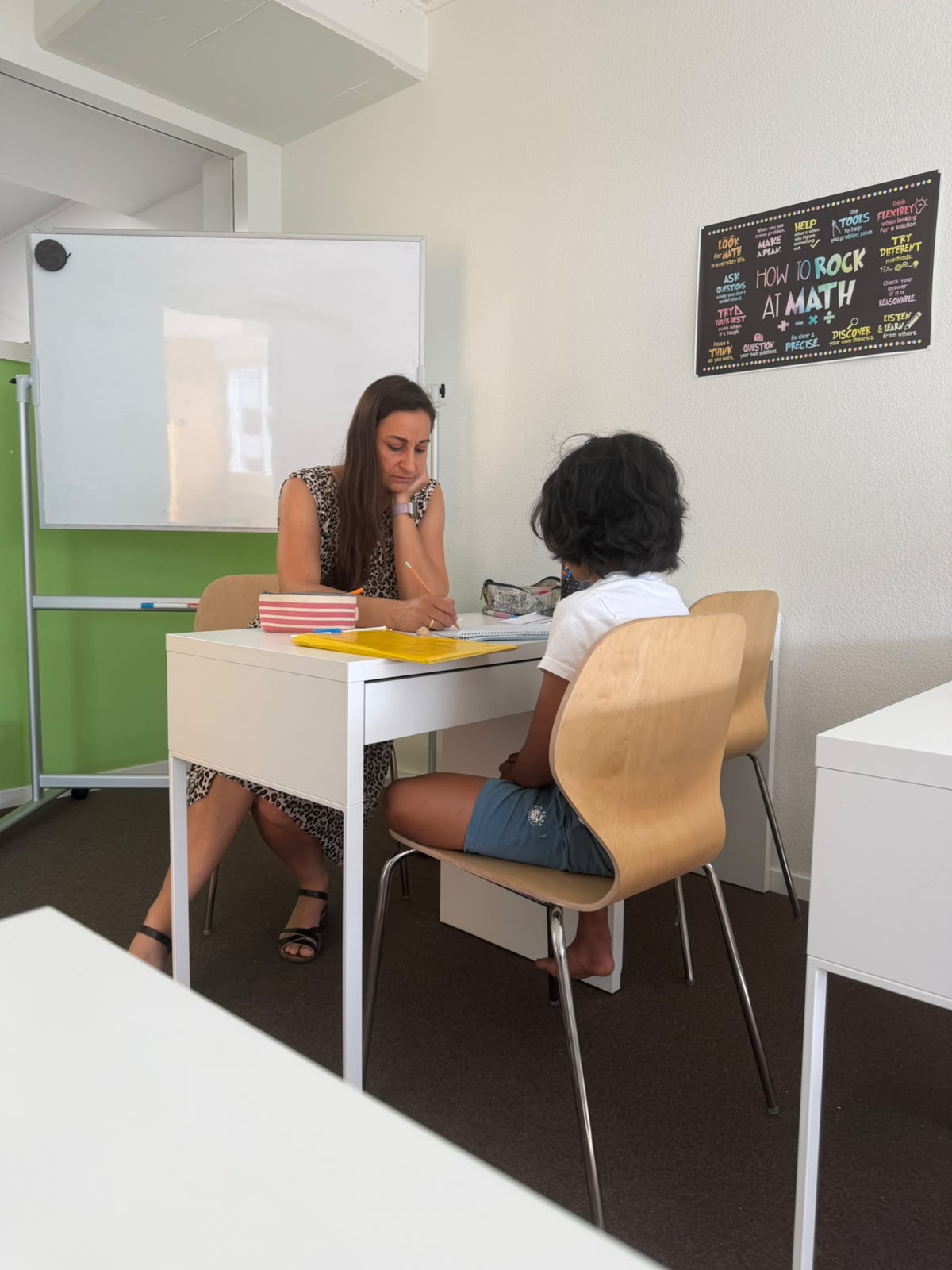
Then comes the actual working phase. If a new concept has to be explained, the teacher can first show a route to the solution or work it out together with the child. After that the child works as much as possible on its own.
What interests us here is not only the result. We want to understand the thinking behind it.
When a mistake happens, the correct answer therefore does not always have to be given straight away. Questions can help instead: up to which point is your route correct? What did you do at this step? Which information from the task do we need here? What could the next step be?
In this way the child should learn to check its own route to the solution more and more itself.
At the end a short summary can follow: what did I understand today? What can I do better now than before? What would I still like to practise?
Depending on the situation, a small and clearly limited task for home can make sense.
Learning how to learn: what should remain beyond the tutoring
Tutoring should not only help to get through the material for the next exam. A child can also get to know strategies it can later use independently.
Recalling instead of only rereading
Anyone who reads their notes several times quickly gets the feeling: «I know this.»
Another possibility is to close the exercise book and try to reproduce what has been learned from memory. What do I still know? What can I explain? Where am I unsure?
That makes it visible more quickly which contents are already available and which should be looked at again.
Spacing out the learning
Instead of working through all the material in one long session right before an exam, several shorter learning phases spread over a number of days can make sense.
That gives the child the chance to recall and apply the content repeatedly.
Mixing different task types
Many similar tasks can help to practise a new calculation route at first. As confidence grows, though, a child should also work on different task types.
Because in an exam it rarely says above a question: «now use method A.» The child has to recognise for itself which approach fits.
Explaining
A good way to check your own understanding is to explain. Can the child describe to someone else, understandably, how a task works?
While explaining, it often notices itself which steps are already clear and where uncertainty remains.
Exam preparation with a system
For an upcoming exam a structured sequence can help. First it should be clarified: what is being tested? Which topics belong to it? Which task types can appear? What can the child already do reliably? Where is there still uncertainty?
After that, work can be targeted at the areas that genuinely need support. Later it can make sense to work on tasks under more realistic conditions as well, for example within a limited time and without additional help.
Alongside subject knowledge, simple exam strategies can help too:
- Read the questions carefully first.
- Start with the questions whose solution is clear.
- Do not get stuck too long on a difficult question.
- Keep an eye on the time.
- Check your work at the end if possible.
Strategies like these do not replace subject knowledge. But they can help to use existing knowledge in a more structured way during an exam and to reduce avoidable mistakes.
How long does tutoring take?
There is no serious general answer to that.
A clearly limited gap in knowledge is something different from uncertainties that have built up across several topics or school years. Short term exam preparation in turn pursues a different goal than building better learning strategies or more independence. Children also learn at different speeds.
That is why at Brainorithmics we do not want to promise a particular number of lessons before we know the child and the starting point.
First we look at this: where does the child stand? What is the concrete goal? Which foundations are in place? Which form of support seems sensible?
After that it is easier to judge what the next steps can look like. And if we think that tutoring is not the right offer at the moment, we want to communicate that just as openly.
Working together with parents and the school
Tutoring should not take place completely detached from school life. It helps, for example, to know when an important exam is coming up, which topics are currently being covered or where the teacher at school observes difficulties.
In return we want to give parents feedback they can follow about what is being worked on and what developments we see.
We orient ourselves towards the school lessons and the requirements that are relevant for the child. If a particular calculation route or method is used at school, we take that into account as far as possible so that no unnecessary confusion arises. Other routes to the solution can be shown in addition when they help understanding.
One further point matters to us: tutoring should relieve family life as far as possible, not add to the burden. If, despite the tutoring, there is long studying every evening or homework regularly leads to conflict, it is worth looking at things together more closely.
How parents can recognise progress
School results are important, of course. But progress can already become visible before it shows up directly in a grade.
- A child starts a task more independently.
- It can say more precisely what it does not understand.
- It discovers a mistake of its own.
- It uses a learning strategy that helps it.
- It explains a route to the solution more clearly.
- It asks when something is unclear.
- It approaches an exam in a more structured way.
- It needs less support with certain tasks than before.
Changes like these are important signs that understanding, working method or independence are developing. Whether and when this shows up in a particular grade cannot be promised.
That is why the next exam is not the only thing that matters to us. In the long run it is about a child understanding better and better how it can learn itself and deal with difficulties.
Tutoring in Aarau, Cham and online
We offer our tutoring at our locations in Aarau and Cham. Depending on subject, age and starting point, online lessons can be an option too.
Whether lessons on site, online, individually or in a small group fit better cannot be decided by age alone. Among other things, the learning goal, the child's way of working, the subject and the kind of support needed are decisive.
Whatever the format, our aim stays the same: not to work through as much material as possible in as little time as possible. Instead, to find out together where support is needed, to make connections understandable and to guide the child step by step towards more confidence and independence.
Good tutoring should make children more independent in the long run
Perhaps a child comes to tutoring and thinks: «I cannot do this on my own.»
Our aim should not be that months later it thinks: «I can only do it when my tutor is sitting next to me.»
A different development matters far more: «I know how to start.» «I can find out where my mistake is.» «I know strategies that help me.» «And when I do not understand something, I know how to ask specifically.»
That is exactly why good tutoring does not simply mean more lessons for us. It means first understanding where a child needs support, starting there in a targeted way and at the same time building skills that reach beyond the next homework or exam.
Because in the end one of the finest goals of tutoring is this: that less and less tutoring is needed.
Which support fits your child?
If you are unsure whether tutoring is the right offer for your child, talk to us. Together we look at where your child currently stands, which goal is being pursued and which support could make sense.
That can be individual tutoring. It can be a small group. In maths, our systematically structured maths programme or another mathematical offer may fit better. And sometimes a different form of support makes more sense than tutoring.
For us it is not about recommending as many lessons as possible. It is about finding support that fits the child, the learning goal and the current situation.
Frequently asked questions
From what school year does tutoring make sense?
Tutoring can already make sense in primary school. More important than the school year, though, is the specific situation. When uncertainties keep coming back, foundations are missing or a child increasingly struggles to follow the lessons, it is worth looking more closely. In maths in particular, gaps can affect further topics over time, because many contents build on one another. It can therefore make sense to clarify difficulties early, without turning every temporary uncertainty into a problem straight away.
My child does not want tutoring. What can we do?
Take the resistance seriously. Some children first associate tutoring with the feeling that they are not good enough in a subject or that something is wrong with them. That is why it matters to us not to present tutoring as a punishment, but as support for a concrete goal. A first lesson can serve to get to know the teacher and the way of working. After that you can discuss together whether the child feels comfortable and which form of support could make sense. It also helps to choose a goal the child itself can follow, for example understanding word problems better or being able to prepare for an exam more confidently.
What does tutoring at Brainorithmics cost?
The cost depends on the chosen format, the subject and the scope of the support. Individual tutoring and small groups differ in structure and price, for example. Just write to us with your child’s school year or level, the subject you have in mind and a short note on where support is needed. Then we can tell you which offer comes into question and what costs are involved.
Do you work with the school textbook?
Yes, when it makes sense for the learning goal. The school material helps us understand how a topic is built up in class and what is currently required. We follow the school approach as far as possible so that different methods do not create unnecessary confusion for the child. In addition we use our own material where needed, for example when foundations have to be rebuilt, intermediate steps made clearer or particular task types practised in a targeted way.
Is tutoring also available online?
Depending on the subject, age, learning goal and the child’s way of working, online tutoring can be a good option too. For pupils who work independently, or for targeted exam preparation, video lessons can be practical. For younger children, or when a lot of direct guidance is needed, lessons on site can fit better. Which variant makes sense is best discussed individually.
Can you support us during the holidays as well?
Depending on availability, support during the school holidays is possible too. The holidays can be a good opportunity to look at foundations calmly or to consolidate particular topics, because no new school material is arriving daily at the same time. At the same time the holidays should remain a time to rest. The scope and goal of the support should therefore suit the child and the particular situation.
How often should tutoring take place?
That depends on the learning goal and the starting point. For many children a regular weekly rhythm can make sense. With an upcoming exam, a clearly limited question or larger gaps in knowledge, a different rhythm can fit temporarily. What matters to us is not planning as many lessons as possible. Between lessons the child should also have the chance to work independently and to apply the strategies discussed in everyday school life.
Does Brainorithmics only offer maths tutoring?
No. Maths is the subject we support most often. Depending on demand, we also offer tutoring in German, English and further school subjects. Whether we can currently offer the right support for a particular subject and school level is something we are happy to clarify individually.
Are individual lessons or a small group better?
Both formats can make sense. Individual lessons allow very personal guidance and can be suitable for targeted gaps in knowledge or intensive exam preparation, for example. In a small group children can additionally learn from each other, get to know different routes to a solution and work together. Which form fits better depends on the child, the subject and the particular learning goal.
Where does the tutoring take place?
Our tutoring takes place at our locations in Aarau, Laurenzenvorstadt 77, and in Cham, Riedstrasse 3. Depending on subject, age and learning goal, online lessons can also be possible.