- Why does a mathematical rule actually work?
- Can you encrypt a secret message with maths?
- Why do certain patterns keep turning up?
- Is there a biggest number?
- And how did mathematicians come up with their ideas in the first place?
Children ask questions that go far beyond a single sum.
At school, many important learning goals, different levels of progress and a shared curriculum all have to be taken into account. So there is not always the same amount of room for mathematical questions that lead beyond the current lesson topic.
This is exactly where the Brainorithmics MATH Club comes in.
The MATH Club is not an extra school lesson and it is not tutoring. It is a meeting place for children aged 8 and up who want to discover maths, question it and think further together.
No grades. No test. And no expectation that every question has to be solved within a few minutes.
Because sometimes mathematics begins exactly where the solution is not yet known.
What is the Brainorithmics MATH Club?
The MATH Club is a regular meeting place for young explorers of mathematics.
Ten meetings take place over the course of the year. Each meeting is devoted to a mathematical topic, a special question or a challenge.
It can be about numbers. About patterns. About logic. About secret codes. About mathematical puzzles. About maths in nature, technology or everyday life. Or about the people and stories behind mathematical discoveries.
The central question is not: «How fast can you calculate?»
But rather:
- «What do you notice?»
- «Why might that be the case?»
- «Is there another way?»
- «How can we find out whether our idea is right?»
The MATH Club gives children time for exactly these questions.
Mathematics is more than calculating
Many children first meet mathematics mainly through sums. Adding. Subtracting. Multiplying. Fractions. Percentages. Equations.
All of that is part of mathematics. But mathematics is much more than that.
Mathematics also means:
- recognising patterns
- making conjectures
- discovering structures
- breaking problems down
- ordering information
- explaining connections
- comparing strategies
- and sometimes thinking about a single question for a long time
This is exactly the side of mathematics we want to make visible in the MATH Club.
The point is not to solve as many tasks as possible. Sometimes one good question is enough for a whole meeting.
Who is the MATH Club for?
The MATH Club is aimed at children aged 8 and up who enjoy asking questions, puzzling things out, discovering patterns or thinking together about mathematical problems.
One thing matters to us particularly: the MATH Club is not only for children with top marks. A particular school grade is not a requirement.
A child can find maths exciting and still have difficulties with individual school topics. Another calculates very confidently at school and is looking for extra challenges. Yet another is less interested in classic sums but is fascinated by logic puzzles, codes or mathematical stories.
What matters is not the school report. What matters is the willingness to engage with questions, to try things out and to think together.
Why from age 8?
Our tasks, conversations and challenges in the MATH Club are designed for children from around 8 years of age.
Many activities assume that children can follow a shared question, bring in ideas of their own and engage with different ways of solving a problem.
We do not expect all children to concentrate for the same length of time or to put their thoughts into words in the same way. Even within one age group there are big differences. So tasks can be supported, extended or simplified in different ways.
The focus is not on everyone finding the same solution at the same time. Far more interesting is often how differently children approach the same question.
Which topics come up in the MATH Club?
The topics can change from meeting to meeting. That is part of the idea: children should experience how varied mathematics can be.
Possible topics are, for example:
Secret codes and encryption
How can you change a message so that not everyone can read it straight away? How might a code work? And which information helps to crack it?
Tasks like these connect mathematics with logic, patterns and systematic thinking. The children try out their own ideas, develop rules and test whether their encryption really works.
Number patterns and surprising connections
Some sequences of numbers look random at first. Then someone discovers a rule. Perhaps it works for the next three numbers. But does it always work?
This is exactly where it gets mathematically interesting. The children observe, compare, make conjectures and check their ideas.
Not every conjecture has to be right. Finding out why an idea does not work is also part of mathematical thinking.
Logic puzzles and open problems
With many school tasks it becomes clear fairly quickly which operation is needed. With a logic problem even the first question can be harder:
- Where do we even start?
- What do we know?
- Which information is important?
- What can we rule out?
- Which possibilities are there?
The children do not simply memorise a particular method. They develop strategies for approaching an unfamiliar problem step by step.
Maths in nature, technology and everyday life
Where do we find mathematics outside a textbook? In buildings? In plants? In music? In computers? In maps and navigation? In space travel?
We meet mathematical structures in many areas. Topics like these can show children that mathematics does not only consist of tasks, but is also a tool for describing patterns, sizes, relationships and structures in our world.
The people behind the mathematics
Mathematics has a history. Behind well known ideas there are people who asked questions, developed conjectures, made mistakes and looked for new ways.
That is why mathematicians and their discoveries can also play a part in the MATH Club.
Their stories show: mathematics was not simply «finished» at some point. Many mathematical insights came about because someone looked more closely and asked a new question.
How does a meeting work?
The exact flow depends on the topic in question. Even so, a meeting follows one clear basic idea: the children should think and discover as much as possible for themselves.
At the start there is often a question, a puzzle, a story or a surprising observation. Something that makes them curious.
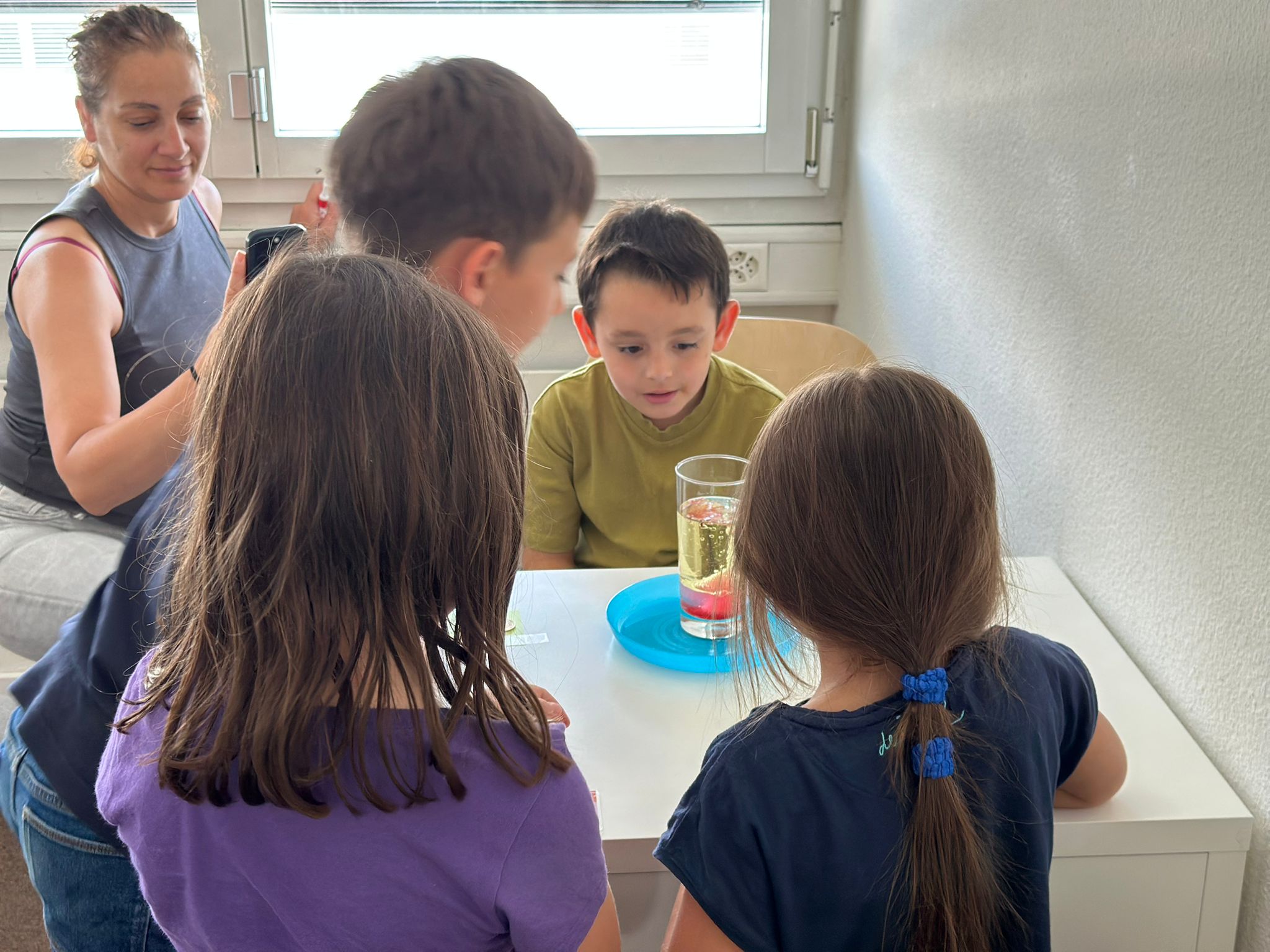
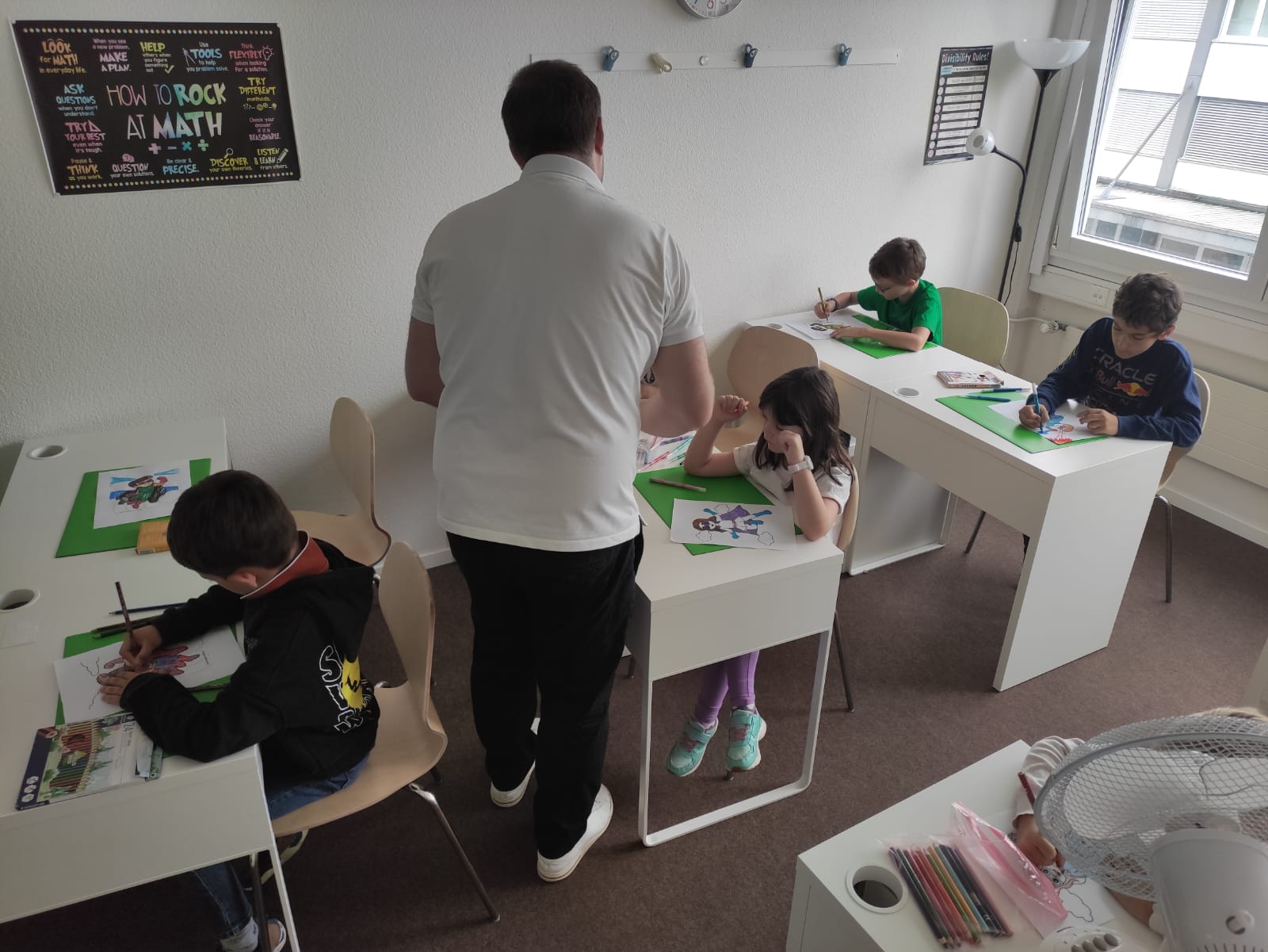
Then the shared exploring begins. The children can think on their own, work in pairs or discuss their ideas in the group.
The person leading the session does not hand out every method straight away. They ask questions. They pick up the children's thoughts. They write down conjectures. They give hints when hints are needed. And they help to make different ways of solving a problem visible.
Because sometimes the solution is not the most exciting part. The way there is.
An example: 1 + 2 + 3 + ... + 100
What is 1 + 2 + 3 + 4 + ... + 100?
Of course you could start by adding all the numbers one after another. But is there a cleverer way?
This is exactly where mathematical discovery begins. At some point someone may notice:
- 1 + 100 = 101
- 2 + 99 = 101
- 3 + 98 = 101
Again and again, pairs appear with the same sum. How many such pairs are there? 50.
Suddenly the long calculation shrinks to 50 × 101 = 5050.
According to a well known anecdote, the mathematician Carl Friedrich Gauss is said to have found a particularly clever way to solve a sum like this while still a schoolboy.
For the MATH Club, though, knowing the story by heart is not what matters. What is exciting is the thought behind it: do I really have to work everything out one by one, or can I discover a structure?
That kind of change of perspective is exactly what we want to make possible.
Not knowing straight away is allowed
One important experience in the MATH Club is this: a task may be difficult. An idea may not work at first. A question may stay open for a while.
That does not automatically mean somebody is «bad at maths». On the contrary: many interesting mathematical problems cannot be solved within a few seconds.
So we give children room to try things out. Perhaps a method starts promisingly and still does not lead to the goal. Then we look together: where is the problem? What can we change? Is there another idea?
Mistakes and detours are not a disruptive part of the meeting. They can themselves become a new mathematical question.
Thinking together rather than just comparing solutions
Mathematics is often seen as something you do on your own. Read the task. Calculate. Write down the result.
In the MATH Club, mathematics may also be a conversation.
One child explains its idea. Another has found a different way. Someone discovers an exception. Another child asks: «But does that always work?»
Conversations like these are valuable because children have to put their own thoughts into words. They hear other ways of solving a problem. They can disagree. They have to give reasons.
And sometimes several half ideas together turn into a new solution.
Which abilities get room in the MATH Club?
The club is not geared towards grades or test results. Even so, the children engage with many abilities that matter for mathematical thinking.
Staying with a difficult question
Not every task works out straight away. Children get to experience that it is normal to change an idea several times and to try different ways.
Making conjectures
«I think that ...» is often the beginning of a mathematical discovery. Then comes the decisive question: «Why do you think so?»
Giving reasons
Knowing a result is something different from being able to explain why it is right. That is why we talk about ways of solving a problem and not only about solutions.
Recognising patterns
What repeats? What changes? What structure lies behind it? Discovering patterns belongs to many areas of mathematics.
Comparing methods
Two correct solutions can look very different. Which one is particularly clear? Which one also works with bigger numbers? Which idea can be carried over to other tasks?
Thinking further together
Children hear other people's ideas and develop them further. That way mathematics becomes not only an individual task but a shared process of thinking.
What is the connection to school?
The MATH Club is deliberately not exam training and not tutoring. Even so, the children engage with ways of thinking that can also play a part in maths lessons at school. For example:
- reading tasks carefully
- ordering information
- recognising patterns
- checking different methods
- giving reasons for conjectures
- examining mistakes
- and not giving up straight away on a difficult question
Whether and how experiences like these show up in everyday school life differs from child to child.
So our goal is not to achieve a particular grade with the MATH Club. Rather, we want to give children the chance to experience mathematics in a different setting.
Why the MATH Club is not tutoring
This distinction matters.
In tutoring, a concrete need for support at school is the focus. Perhaps there are uncertainties with fractions. Perhaps an upcoming test is causing difficulties. Perhaps foundations from an earlier topic are missing. Then the child needs targeted support at exactly that point.
In the MATH Club, by contrast, there is no particular school material that has to be caught up on. We do not work towards the next test. And we do not base the meetings on whichever chapter of the textbook is currently being covered.
The club opens a different space: for questions, for mathematical discoveries, for puzzles, for unusual methods and for topics that go beyond the current school material.
MATH Club, maths programme or tutoring?
Brainorithmics offers different kinds of maths. They pursue different goals.
Tutoring
Tutoring is the right fit when a concrete school topic, a gap in knowledge or an upcoming test is the focus. The support is based on the child's current situation.
Maths programme
Our maths programme builds mathematical foundations, understanding, calculation strategies and logical thinking systematically over a longer period. It is about a structured learning path that leads on step by step.
MATH Club
The MATH Club is for children who want to discover mathematics beyond the school curriculum. No particular school grade is the focus here. It is about curiosity, mathematical questions and thinking together. A child does not need top marks for it.
If you are not sure which offer suits your child, we can look together at which goal is currently most important.
And if maths is difficult at school right now?
A child who is not confident in every area of maths can still enjoy mathematical puzzles and discoveries. So a school grade alone does not decide whether the MATH Club might be interesting.
If, however, a concrete difficulty at school is currently the main issue, it is worth looking more closely:
- Does the child need support with a particular topic?
- Are foundations missing?
- Is it about a test?
- Or is the child looking for additional mathematical challenges regardless of that?
Depending on the situation, tutoring, our maths programme or the MATH Club can be different options.
The point is not to combine as many offers as possible. The point is to find out which kind of support or challenge makes sense right now.
Ten meetings a year
The MATH Club consists of ten meetings a year. That keeps it a regular, recurring and yet special activity alongside school and other free time activities.
Each meeting can be devoted to a topic of its own. Over the course of the year the children can get to know very different sides of mathematics.
One time it may be about a famous mathematician. At the next meeting about a puzzle. Then about patterns. Codes. Strategies. Geometry. Or mathematics in a surprising context.
The result is not a second maths lesson following the school plan, but a journey through different mathematical ideas.
What parents can do at home
Parents do not have to be mathematicians themselves to support mathematical curiosity. Often one good question is enough.
Instead of only asking: «Is the result right?» you can ask: «How did you come up with that?» Or: «Is there another way?»
If your child asks a question you do not know the answer to yourself, that does not have to be a problem. «I don't know either. How could we find out?» can be a wonderful beginning.
Remarks like «I was never good at maths either.» are usually well meant too. But they can unintentionally suggest that mathematical ability is something fixed.
Another option would be: «I found that difficult too back then. Show me how you are thinking about it.»
That way the question stays open. And that is often exactly what makes it mathematically exciting.
How parents can recognise interest and enjoyment
In the MATH Club there is no grade from which progress can be read. That is not the aim either.
Some children talk at length after a meeting. Others hardly say anything and keep thinking all the same.
Possible signs that a topic has sparked interest can be:
- Your child tells you about a question or discovery from the club.
- It wants to explain a method to you.
- It thinks about a puzzle again later.
- It starts asking mathematical questions of its own.
- It discovers patterns or connections in everyday life.
- It tries different ways when facing a challenge.
Not every child has to show all of these things. What matters more is whether it enjoys engaging with this kind of mathematical thinking.
The MATH Club at Brainorithmics
The MATH Club is meant to be a place where mathematics does not begin with the right result. It begins with a question.
- Why?
- What do you notice?
- What if ...?
- Does that always work?
- Can you explain your idea?
Children may try things out, discuss, discard, start again and develop solutions together. They get to experience that a difficult question does not have to be threatening. And that mathematics does not only consist of applying rules.
It can be surprising. Creative. Historical. Logical. Sometimes puzzling. And sometimes so exciting that a single question is enough for a whole meeting.
That is exactly what the Brainorithmics MATH Club is for: a meeting place for children who want to discover mathematics, question it and think further together.
Because mathematics is something you can discuss, marvel at and think about together.
Frequently asked questions
From what age is the MATH Club suitable?
The MATH Club is aimed at children aged 8 and up. The tasks, conversations and mathematical challenges are designed so that children can bring in their own ideas, make conjectures, compare different methods and think about mathematical questions together. Not all children have to work at the same speed or express their thoughts in the same way. What matters most is the joy of discovering, puzzling things out and engaging with new questions.
Does my child have to be particularly good at maths?
No. A particular school grade is not a requirement for the MATH Club. Nor is the club aimed exclusively at highly gifted or particularly high achieving children. Some children calculate very confidently, others are especially interested in puzzles, patterns, logic or unusual mathematical questions. What matters most is curiosity and the willingness to think about a question even when the solution is not immediately visible.
How often does the MATH Club meet and how long is a meeting?
The MATH Club consists of ten meetings a year. Each meeting is devoted to its own mathematical topic or a special question and lasts 120 minutes. You will find the current dates in the MATH Club description. That way you can see before registering when and in what setting the next meeting takes place.
Is the MATH Club tutoring?
No. The MATH Club and tutoring pursue different goals. In tutoring, a concrete need for support at school is the focus, for example a gap in knowledge, a current lesson topic or preparing for a test. In the MATH Club, by contrast, no particular school material is caught up on and nobody works towards the next test. Here it is about discovering mathematics beyond the school curriculum, asking questions, recognising patterns, trying out methods and thinking further together.
Which topics come up in the MATH Club?
The topics can change from meeting to meeting. Possible focuses are, for example, secret codes and encryption, number patterns and special numbers, logic puzzles and mathematical brain teasers, geometry and spatial thinking, maths in nature, technology or everyday life, and stories about mathematicians and their discoveries. Not every topic has to come up every year. The variety itself is part of the idea of the MATH Club.
Is there any homework, and are there grades or tests?
No. In the MATH Club there are no grades and no tests. Classic homework that has to be done by the next meeting is not part of the idea either. Of course it can happen that a question keeps a child so busy that it carries on thinking about it at home of its own accord, or brings a new idea to the next meeting. That is welcome. It is not expected.
My child is having difficulties in maths at the moment. Does the MATH Club still fit?
That cannot be answered on the basis of a school grade alone. A child who has difficulties with individual mathematical topics can still take great pleasure in logic puzzles, patterns or mathematical discoveries. If, however, a concrete problem at school is currently the main issue, for example missing foundations, uncertainty with a particular topic or an upcoming test, tutoring or our systematic maths programme may be more suitable. We are happy to look together at which offer suits your child’s current situation and goal.
Can my child join during the year?
Since the meetings deal with different mathematical topics, joining during the year can in principle be possible. Whether a place is currently available and which meeting suits your child depends on the group and the current offer. Feel free to ask us about the next opportunities.
Does my child have to attend all ten meetings?
How taking part is organised depends on the MATH Club offer in question and on the form of participation chosen. Since the meetings deal with different topics, each date focuses on a new mathematical question. You will find the exact conditions in the current description.
What does taking part in the MATH Club cost?
You will find the current prices and ways of taking part in the MATH Club description. If special conditions apply to children already attending Brainorithmics courses, they are stated there too. That way you can see straight away which option comes into question for your child.
How big is a MATH Club group?
We deliberately want to keep the groups manageable. The MATH Club lives from children being able to ask questions, express their own ideas, explain methods and respond to other people’s thoughts. So the right group size can differ depending on age, topic and type of activity.
Where does the MATH Club take place?
At our locations in Aarau, Laurenzenvorstadt 77, and in Cham, Riedstrasse 3. You will find the current locations and dates in the MATH Club description. There you can see when the next meeting takes place, which age group it is meant for and at which Brainorithmics location it is offered.