“What should my child actually be able to do in maths?” Many parents ask themselves this question at the latest when an exam goes badly or their child says they no longer understand anything.
The answer is in Lehrplan 21, the curriculum used in the German speaking and multilingual cantons, including Aargau and Zug. It is written for professionals, though. Here you will find the most important points for primary school, grade by grade and in simple words.
How Lehrplan 21 is structured
Lehrplan 21 sets out what children should be able to do at the end of a cycle, not at the end of every school year. Cycle 1 runs from kindergarten to grade 2, cycle 2 from grade 3 to grade 6, and cycle 3 covers upper school.
In maths there are three areas of competence: “Number and variable”, “Shape and space” and “Quantities, functions, data and chance”. Across them run three aspects of action: “Operating and naming”, “Exploring and reasoning” and “Mathematising and representing”. Put simply: a child should not only be able to calculate but also explain why, and translate an everyday situation into a calculation.
Exactly when a topic is covered depends on the canton, the school and the textbook. The following overview therefore shows the typical order, not a fixed timetable.
Grade 1: calculating confidently up to 20
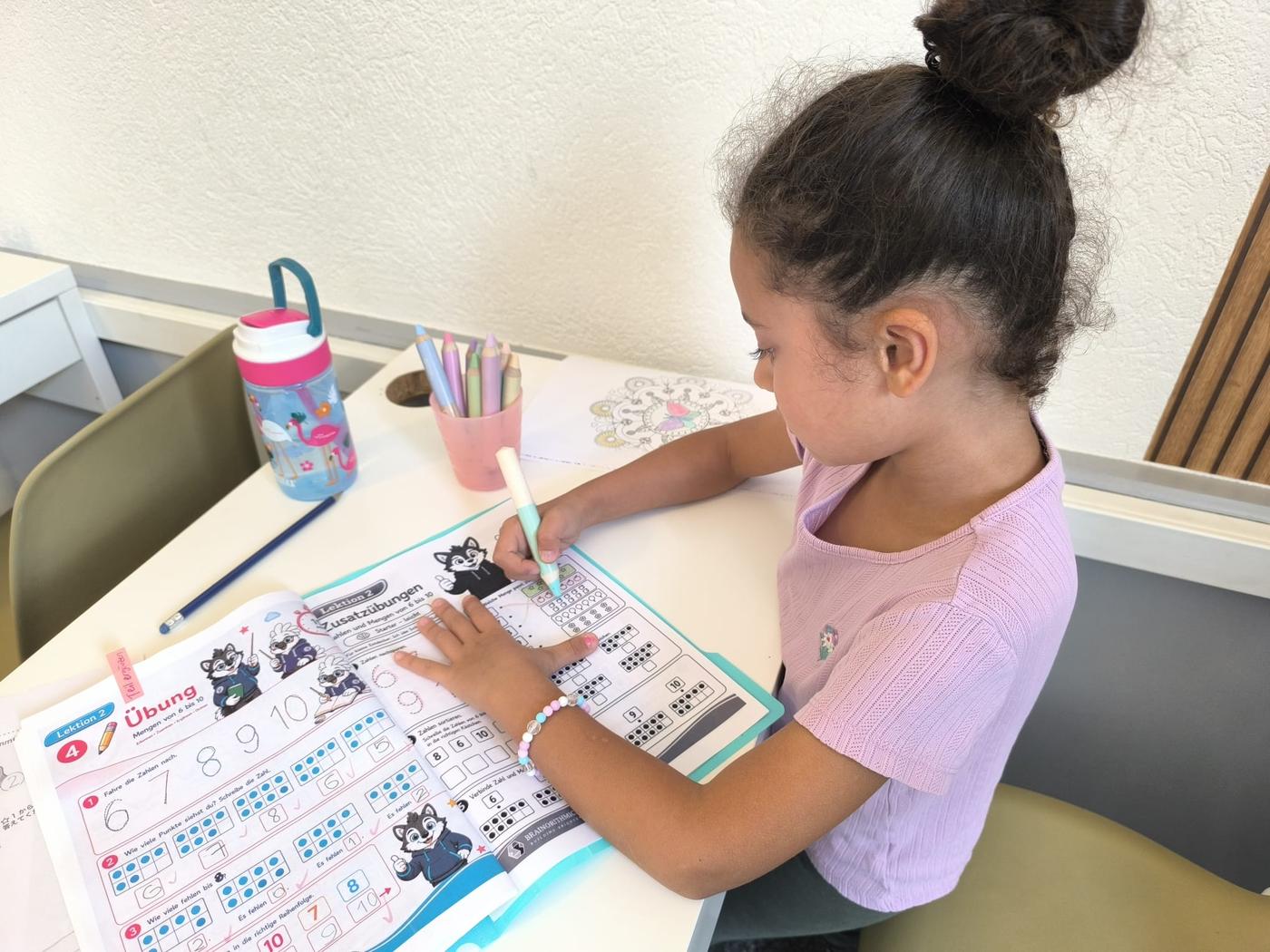
In grade 1 children learn to calculate confidently with numbers up to 20. First it is about adding and subtracting up to 10, then tasks up to 20 without crossing ten, and finally the step across ten, for example with 8 + 5. This very step is the first big hurdle in arithmetic for many children.
- Does your child still count on their fingers, or do they already break numbers down, for example 8 + 5 as 8 + 2 + 3?
- Do they know the pairs of numbers that make 10 without thinking for long?
Material for practice: Maths grade 1
Grade 2: numbers up to 100
In grade 2 the range of numbers grows to 100. Children add and subtract with tens and ones, find missing numbers and read numbers on the number line. The first times tables, money, telling the time and word problems follow, in which children find the right calculation from a short text themselves.
- Can your child explain how they calculate a task like 63 minus 28?
- Do they recognise in a word problem whether to add or subtract?
Material for practice: Maths grade 2
Grade 3: place value and numbers up to 1000
In grade 3 the range of numbers expands to 1000. Children learn how many hundreds, tens and ones there are in a number, find neighbouring numbers, tens and hundreds, and find their way on the number line and in the thousand chart. Mental arithmetic up to 1000, completing to 100 or 1000 and the first written addition are added.
- Does your child know how many hundreds, tens and ones there are in 708, even with the zero in the middle?
- Can they add 380 and 50 in their head without losing track?
Material for practice: Maths grade 3
Grade 4: large numbers up to a million
Grade 4 is about numbers up to a million. Children write number words as digits, break down and compare numbers, place them on the number line and round to thousands, ten thousands and hundred thousands. Alongside this the four basic operations are consolidated, mentally and in writing, and combined with quantities such as weights and prices in word problems.
- Does your child write “three hundred and forty thousand and five” correctly in digits?
- Do they estimate a result first before calculating in writing?
Material for practice: Maths grade 4
Grades 5 and 6: fractions, rules of calculation and geometry
In grades 5 and 6 maths becomes more abstract. Fractions are at the centre: recognising and calculating parts, representing fractions with models and on the number line. Decimals and percentages are added, the rules for brackets and the order of operations, rounding and estimating with large numbers, and in geometry line symmetry and reflection in the coordinate system.
These years are also the foundation for the move to upper school and for Gymnasium preparation. Gaps in fractions or in the rules of calculation show up there immediately.
- Can your child show 3/4 on a rectangle, on a circle and on the number line?
- Do they know why 5 + 3 · 4 does not make 32?
Material for practice: Maths grades 5 and 6
What to do when a foundation is missing
In maths almost everything builds on what came before. Uncertainty about place value in grade 3 becomes visible in grade 4 with the million and in grade 5 with decimals. That is why, when there are difficulties, it is worth not only practising the current chapter but looking at which foundation is missing underneath.
That is exactly how we work: in tutoring we go back to the foundation that is missing when necessary, and our maths courses build understanding of numbers and calculation strategies independently of the current chapter. You will find all assessments and workbooks in our learning world.
Frequently asked questions
What does “cycle” mean in Lehrplan 21?
Lehrplan 21 sets goals for periods of several years, not for each school year separately. Cycle 1 runs from kindergarten to grade 2, cycle 2 from grade 3 to grade 6, and cycle 3 covers upper school.
Why does my child learn a topic earlier or later than described here?
Because Lehrplan 21 sets goals per cycle. Exactly when a topic is covered depends on the canton, the school and the textbook. The overview shows the typical order.
How can I find out whether my child is on track?
The questions under each grade give a first impression. Our assessments in the learning world show it more precisely, each with an answer sheet. And in a free trial lesson we see together where your child stands.
Does Lehrplan 21 also apply in the cantons of Aargau and Zug?
Yes. The canton of Zug teaches according to Lehrplan 21, and the Aargau curriculum for compulsory school is also based on Lehrplan 21. Our locations in Aarau and Cham therefore work with the same content.