One of the questions we hear from parents most often sounds almost apologetic: “My child actually has good marks. Do they need a maths course at all?”
They do not have to need it. But “need” is not the only question. The better one is: what would do my child good?
What a good mark shows and what it does not
A mark measures whether a child could solve the tasks of an exam at a particular moment. It says little about how they solved them. Two children with the same mark can think very differently: one has memorised the procedure, the other understands why it works and could show a second way.
The difference often only shows later. In grades 5 and 6 maths becomes more abstract: fractions, decimals and percentages, rules for brackets and the order of operations, symmetry in the coordinate system. Children who have done well so far by memorising sometimes hit a limit there for the first time, and that in the very years before the move to upper school or Gymnasium.
How to tell that your child wants more
- They finish their homework in a few minutes and are bored in class.
- They ask questions that go beyond the material: why is that so? Is there another way?
- They like riddles, puzzles or strategy games.
- Or the opposite: they have good marks but say maths is boring or “not for me”.
The last sign in particular is easy to overlook. A child who feels unchallenged sometimes loses interest in a subject they are actually strong in.
What a course gives a child with good marks
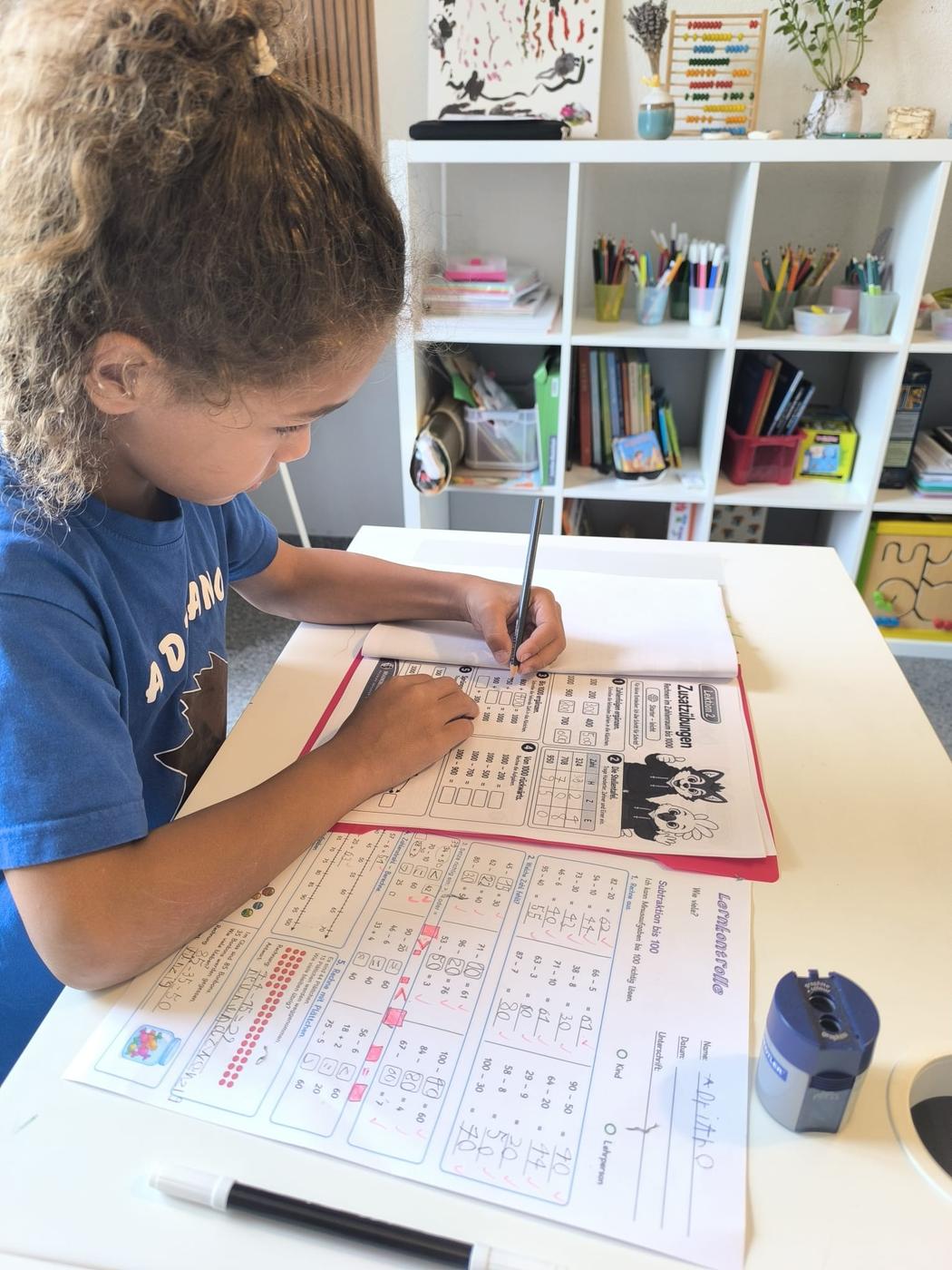
In our maths courses every child works at their own level within the group. Those who are quicker get more challenging tasks. For a child with good marks this means they are not kept busy with more of the same but with tasks they do not know yet.
For us the right result is not the only thing that counts. We look at the way of thinking: can I explain my solution and perhaps find a second one? In a school class with many children there is often little room for this question. In a group of at most eight children, usually four to six, there is.
There is also something that marks do not measure: confidence with tasks whose solution is not obvious. A child who has learned to stay with a difficult task takes that into every subject.
And the MATH Club?
For children aged 8 and up who love puzzles there is the MATH Club: 120 minute meetings in which children explore maths beyond the school syllabus. The MATH Club is not a course with a fixed weekly rhythm but a series of individual meetings. It currently takes place in Cham, and the current dates are on the MATH Club page.
What a course should not be
A course for a child with good marks should not create extra pressure or turn into a race. Playful does not mean undemanding for us: puzzles, small competitions and mathematical games require the same skills as a worksheet, but here children want to keep thinking of their own accord.
A free trial lesson in our maths courses in Aarau or in Cham shows best whether this suits your child. If you are thinking more of short term support, our article A course or a few tutoring lessons helps with the decision.
And if it is about a specific gap or an exam rather than more of a challenge, you will find everything you need on our pages about tutoring in Aarau and tutoring in Cham.
Frequently asked questions
Will my child not be held back in the group if others are slower?
No. Within the group every child works at their own level: those who are quicker get more challenging tasks, those who need more time look at a step more closely. The groups have at most eight children.
Does my child simply learn next year’s material in the course?
Not primarily. The course works on four goals independently of the current chapter at school: understanding, strategies, applying and thinking. Children who are quicker get more challenging tasks instead of simply racing ahead in the syllabus.
Course or MATH Club: what is the difference?
The maths course runs regularly and builds a foundation over the school year. The MATH Club consists of individual 120 minute meetings for children aged 8 and up who want to explore maths beyond the school syllabus.
Does a course also help with Gymnasium preparation?
The course lays the foundation that every Gymnasium exam assumes. For targeted preparation for the exam itself we offer Gymnasium preparation as part of tutoring, for grades 5 and 6 and for grade 9, one to one or in a small group.