«I just can’t do it.»
We hear this sentence often.
And very often what lies behind it is not a lack of talent, but something quite different.
Perhaps an important foundation is not secure yet. Times tables still take effort, so fractions suddenly become difficult. Carrying over the ten was never really understood, so working with larger numbers later on costs unnecessary energy. Or one particular topic was not properly understood at the time, and with every new topic the feeling of falling behind grows.
Maths builds on itself more than most other school subjects. New knowledge always connects back to what has already been learned.
When important foundations are shaky, every new topic can therefore create additional difficulty, no matter how much a child practises.
That is exactly why we do not simply rely on more practice at Brainorithmics.
We want to find out where the understanding is missing, and why.
Because a child often does not need more exercises, but a different way in.
This article shows why children sometimes lose the thread in maths, why understanding matters more to us than memorising, how our maths courses are structured and what parents can do at home.
It is written for parents who have the feeling: my child could do more than the current maths grade suggests.
A grade is a clue, not the whole explanation
On its own, a poor maths grade says very little.
It shows that something is not working yet, but not necessarily why.
In our work we come across a number of different causes.
A gap in knowledge
A topic from an earlier school year is not secure yet.
The child therefore needs a lot of attention and energy for simple calculation steps. With more complex tasks, that capacity is then missing for the actual problem.
Here it often does not help to keep practising the current topic.
Sometimes you have to go back first, exactly to the point where the understanding is solid again.
A procedure was learned, but not understood
The child knows the recipe, but not the idea behind it.
As long as a task looks exactly like the one in the exercise book, the procedure works. But as soon as the same mathematical idea is presented differently or wrapped up in a word problem, uncertainty appears.
That is precisely why one thing matters to us at Brainorithmics: not only knowing how something is calculated, but understanding why it works.
A language problem rather than a maths problem
With word problems in particular, the difficulty sometimes has nothing to do with the calculation.
The child does not fully understand the situation described, or does not know which pieces of information matter. Numbers are then combined without it being clear what is actually being looked for.
That is why understanding, structuring and visualising a task is part of maths for us too.
Pace and concentration
Some children understand the material but need more time.
Others make careless slips, lose a digit while copying or skip a step in the calculation.
That calls for a different kind of support than a gap in knowledge does.
Self doubt and negative experiences
Some children have experienced maths as difficult so often that individual setbacks turn into a conviction: «I just can’t do maths.»
They no longer try things out openly. The child already doubts the answer before finishing the calculation.
More worksheets alone rarely help in a situation like this.
That is why we first try to find out where the real difficulty lies, before deciding how to carry on working with a child.
Why we start with understanding
We do not want to hand children calculation routines to memorise.
Our goal is that they understand why a mathematical method works.
Only then can they apply their knowledge when a task suddenly looks different.
A simple example: a child can learn that to divide fractions you turn the second fraction upside down and multiply.
That rule can be memorised.
But why does it work? And what does the calculation actually mean?
If you ask «how many quarters of an hour fit into an hour and a half?», the idea of division is exactly what sits behind it.
We therefore start with the meaning of a task wherever possible, and only afterwards with the quick procedure.
Once a child has understood what is happening mathematically, the rule becomes a helpful shortcut rather than a formula that was only learned by heart.
This way can take more time at the beginning.
In the long run, though, understanding creates a foundation that further mathematical knowledge can be built on.
Maths at Brainorithmics: understand, strategise, apply, think
Our maths courses are therefore meant to be more than extra calculation practice.
Step by step, we want to develop four areas:
- Understanding: what does a number, a calculation or a mathematical relationship actually mean?
- Developing strategies: is there a smarter way? Can I split, complete, compare, estimate or use a pattern?
- Applying: can I use what I know in an unfamiliar task or an everyday situation?
- Thinking: can I see connections, explain my answer and perhaps even find a second route to it?
This development runs through all of our maths levels.
Because our goal is not only that a child solves a task correctly.
It is that the child increasingly understands how to arrive at a solution on their own.
What maths trains beyond the subject itself
Concentration
Thinking a task through from beginning to end without skipping an important step takes attention.
Mathematical tasks offer plenty of opportunities to train exactly that ability.
Confidence in the basics
A child who is secure with the basic operations needs less attention for the individual steps.
That leaves more capacity for the actual problem, for instance for understanding a word problem or developing a strategy.
Number sense
An important part of mathematical competence is being able to judge whether a result is plausible at all.
If a jumper costs 40 francs and is reduced by a quarter, the new price cannot be 5 francs.
Children should therefore not only calculate, but increasingly develop a feeling for one question: can my answer be right at all?
That ability is valuable both at school and in everyday life.
Persistence
Not every task works out on the first attempt.
Looking for a second route, representing something differently or taking a closer look once more is part of mathematical thinking.
Trust in their own thinking
Every task a child has understood and solved by themselves can help to gradually question the belief that «maths is not for me».
That is why the right answer is not the only thing that matters to us. The route to it matters too.
Playful does not mean undemanding
«Learning with fun» is sometimes misunderstood.
For us it does not mean that less is expected.
It means shaping tasks so that children want to think.
A puzzle, a contest within the group, a mathematical game or a brain teaser with a surprising result can demand exactly the same mathematical abilities as a classic worksheet.
The difference lies in how the child experiences the task.
They are not calculating simply because twenty exercises have to be done. They want to find out:
- What comes out of this?
- Is there a trick?
- Can I find a faster way?
- Why does this work?
And one more thing matters to us:
At Brainorithmics a child is allowed to be wrong.
For us mistakes are not only something to be corrected. They can show how a child was thinking.
When three different answers appear within a group, a particularly valuable discussion can grow out of it. Which route works? Where do the approaches differ? At which point did something happen?
That is how a mistake becomes a starting point for understanding.
Our maths levels at a glance
Our maths courses are organised into five levels that build on one another.
Age serves as a rough guide. What matters most is where a child stands mathematically.
Level 1, Little Maths Heroes, around ages 5 to 6
The playful way into the world of numbers.
Children develop a basic number sense, get to know the numbers up to 20, discover quantities and how to split them, and gather first experiences with addition and subtraction.
Goal: not just reciting numbers, but understanding them.
Level 2, Maths Makes Magic, around ages 6 to 7
Now the understanding of numbers is extended.
Children develop strategies for addition and subtraction, increasingly work with larger numbers and gain confidence and routine in calculating.
Understanding still stays at the centre, not just the quick answer.
Goal: confidence with the basic operations and first flexible calculation strategies.
Level 3, Calculate Like a Pro, around ages 7 to 9
Multiplication and division are added.
Children develop an understanding of multiplying and dividing, consolidate important foundations and increasingly apply what they know in word problems and everyday situations.
Goal: calculating confidently and applying mathematical knowledge independently.
Level 4, Number Pro Strategies, around ages 9 to 11
Maths becomes increasingly strategic.
Children work on more demanding word problems, fractions and further mathematical relationships. They compare approaches and develop strategies of their own.
Goal: understanding more complex connections and solving problems strategically.
Level 5, Masters of Number Logic, around ages 11 to 12
Here mathematical thinking moves even further into the foreground.
Fast and clever calculating, number patterns, logic, brain teasers, multi step problems and different solution strategies prepare children for increasingly abstract mathematical thinking.
Goal: recognising mathematical connections, thinking logically and developing their own routes to a solution.
The age ranges are deliberately only a guide.
A child is not automatically placed in a level with us simply because of a certain age or school year.
We want to start where learning can sensibly continue. The courses take place at our locations in Aarau and Cham.
Word problems: when calculating alone is not enough
Hardly any mathematical topic causes children as much frustration as word problems.
Yet the difficulty often does not lie in the calculation itself.
The child first has to understand: what is actually happening here?
That is why we work through word problems step by step.
1. Read and understand
First it is read, without calculating straight away.
What is this about? Can the child explain the situation in their own words?
2. Organise and represent the information
What do we know? What are we looking for?
A sketch, a bar model, a number line or a simple diagram can help to make an abstract situation visible.
3. Estimate
Before any calculating: roughly how big should the result be?
That question helps later on to recognise whether an answer is plausible.
4. Calculate
Only now is a suitable calculation or strategy chosen.
5. Check
Does the result fit the original question? Is the unit correct? Is the order of magnitude plausible?
With practice this sequence can become more and more natural.
The goal is that children eventually stop asking «which calculation do I have to do here?» and start asking «what is happening in this task, and how can I represent it mathematically?».
When maths causes anxiety
Some children do not only have a mathematical gap.
They already have a history with maths.
Perhaps they have had poor grades several times. Perhaps others were faster. Perhaps at some point they began to believe that maths is simply not their subject.
In situations like these it is important not to look only at the current school material.
A child needs experiences again in which they notice:
- I can understand something.
- I can find a way to a solution.
- I am allowed to make a mistake and try again.
It can therefore make sense to start with tasks where confidence is already there, and to move on step by step from that point.
Not to under challenge a child, but to rebuild a stable foundation for further learning.
Our language plays a part in this too.
For example, we do not say: «but this is easy.»
Because what seems easy to an adult can be a genuine challenge for a child right now.
Instead we look at this: what is already correct? Where is the reasoning right? At which point does the route change?
Tutoring, maths course or MATH Club?
Parents ask us this often, and the three offers have different goals.
Tutoring
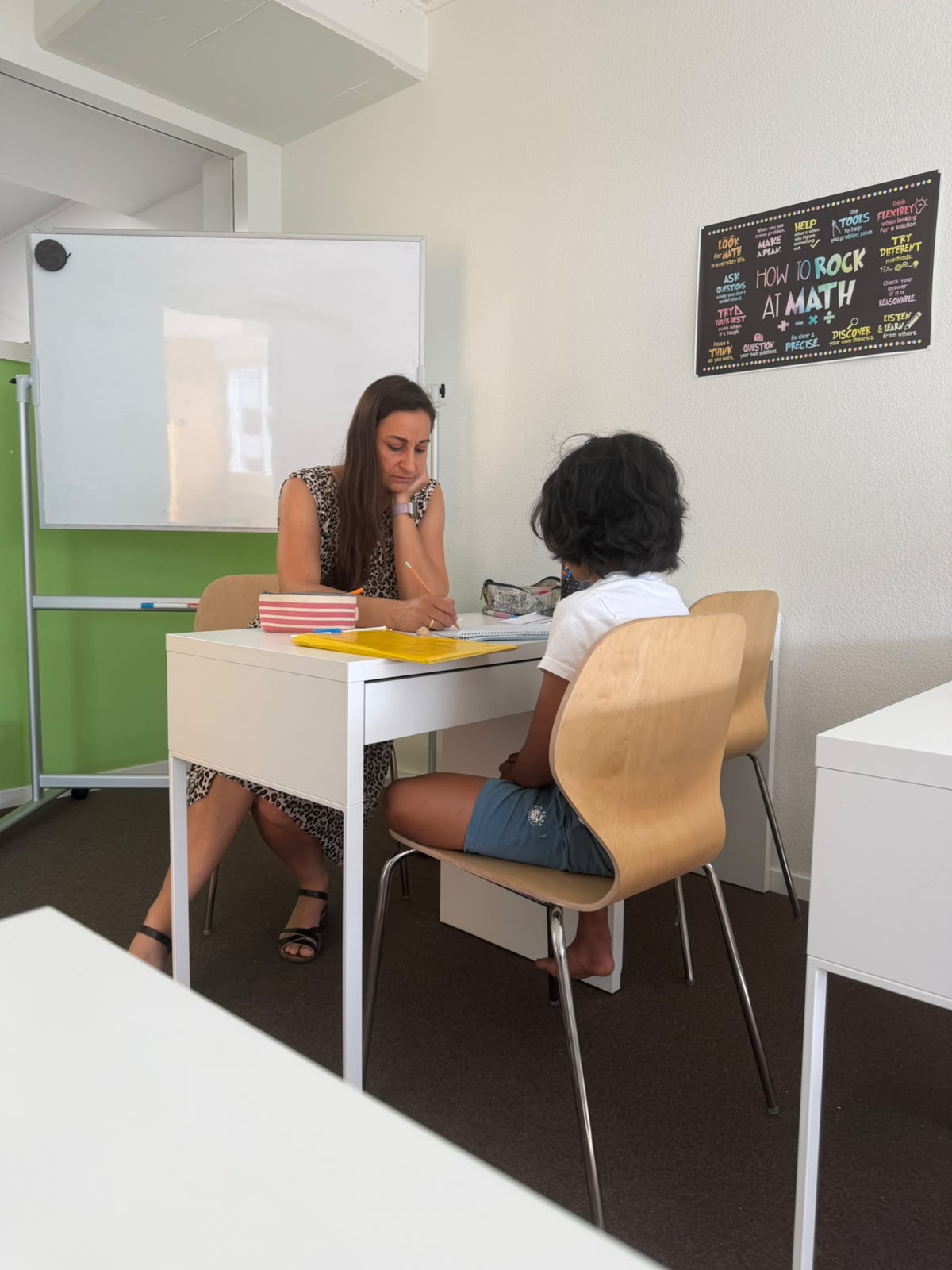
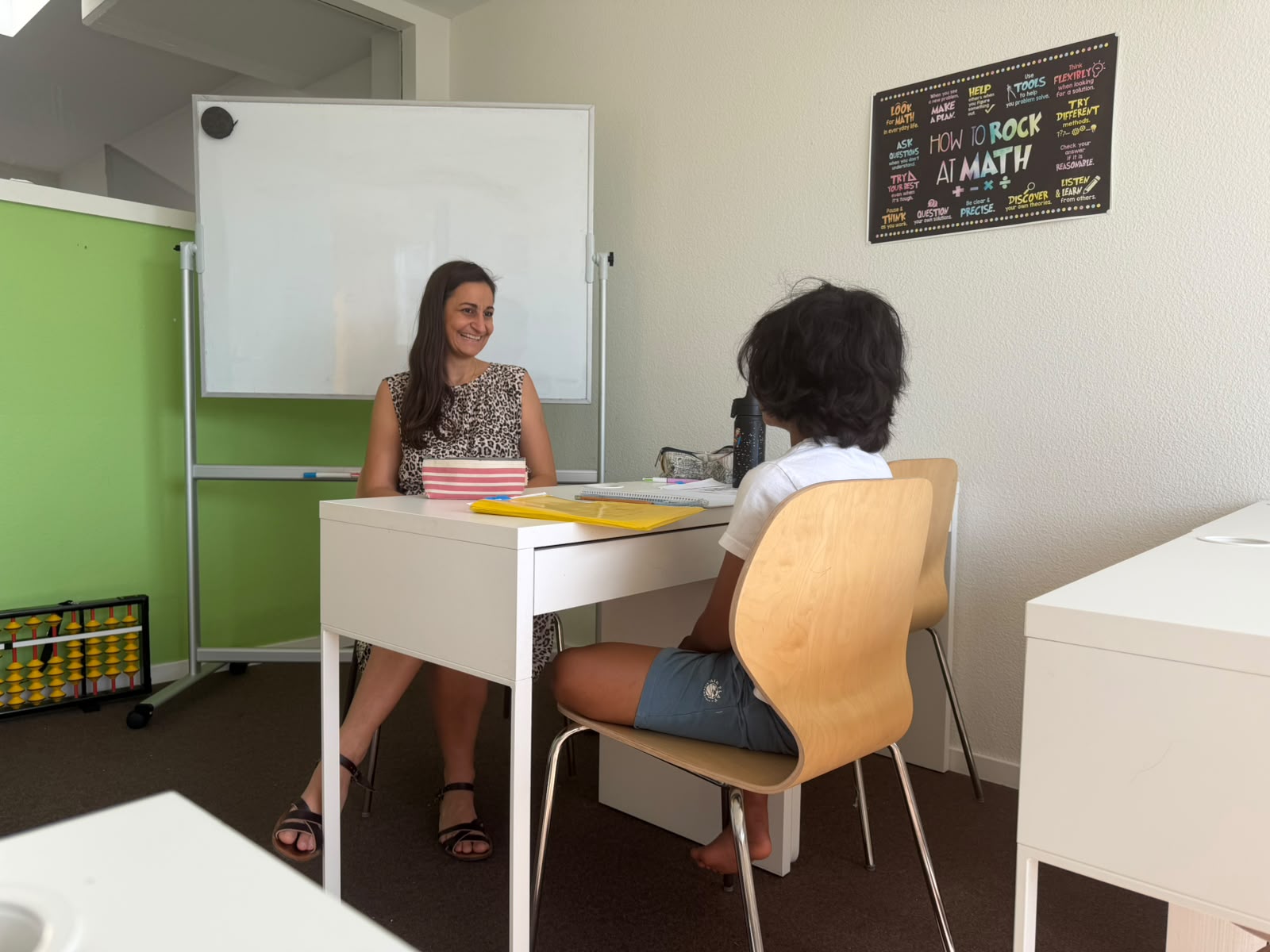
Tutoring makes sense when it is about concrete difficulties at school: a gap in knowledge, an upcoming test, homework or one particular topic.
The focus is more strongly on the current school material.
Goal: closing gaps, gaining confidence and keeping up again.
The Brainorithmics maths programme
Our maths programme is built for the longer term.
It is not guided only by the current school material, but systematically develops number sense, calculation strategies, application and mathematical thinking.
Goal: building a mathematical foundation that also carries the topics still to come.
The Brainorithmics MATH Club
The MATH Club is for children who want to explore maths beyond the classroom.
Here they can puzzle, experiment, discuss and think past the classic school curriculum. Fascinating mathematical topics, logic, number patterns and special brain teasers are at the centre.
Goal: awakening curiosity and nurturing the joy of mathematical thinking.
For children who enjoy puzzling, or who are looking for extra challenge alongside regular maths lessons, this format can be especially exciting.
Not sure which offer suits your child? Then let us look together at where your child stands and which format makes sense.
Transitions and exams: why preparing early helps
For many families maths becomes a topic above all when an important exam or a school transition is coming up.
Two things then sometimes have to be managed at once: the current material has to be secure, and older gaps should be closed at the same time.
The earlier uncertainties are spotted, the more time there is to build the foundations calmly.
When preparing for an exam we therefore look at more than individual tasks.
Strategies can play a part as well:
- Which tasks do I solve first?
- How do I divide up my time?
- What do I do when I get stuck on a task?
- How do I check my answers?
And of course the relevant material is practised in a targeted way.
One thing matters to us here: a single exam does not decide how mathematically able a child is.
It shows a performance in a particular situation at a particular moment.
Our goal is therefore not only the next exam, but as much confidence as possible for what comes after it.
What parents can do at home
You do not have to teach maths lessons at home yourself.
Small everyday things often help more than another worksheet.
Discover maths in everyday life
- How much does that cost altogether?
- How much change will we get?
- How long does the journey take?
- How much is half of it?
- Which pack is better value?
Situations like these show children that maths does not only happen in a school book.
Careful with «I was never good at maths either»
That sentence is usually meant to comfort.
What can reach the child, though, is a different message: «then perhaps it just runs in our family.»
More helpful is: «perhaps nobody has explained it yet in a way that works for you.»
Ask about the route
Not only: «what is the answer?»
But: «how did you get there?»
That question shows far better whether a child has understood a connection.
Keep practice time sensible
Long, frustrated practice is not automatically effective learning.
If homework regularly leads to a lot of stress, that can be a sign that it is worth looking more closely at where the real difficulty lies.
How parents can recognise progress
Progress does not always show up in a grade first.
Sometimes other things change before that.
- A child starts a task without immediately saying: «I can’t do this.»
- They try a second route.
- They spot a mistake of their own.
- They explain how they arrived at an answer.
- They ask not only for the answer, but want to understand why something works.
Changes like these can be important signs that a child is building confidence and trust in their own mathematical thinking.
School results can follow that process, but they are not the only measure of mathematical progress.
Maths can be experienced differently
A child who says «I just can’t do maths» does not automatically need more worksheets.
Perhaps they need a step back. Perhaps a different explanation. Perhaps a picture instead of a formula. Perhaps a strategy. Perhaps a task that makes them curious again.
Or simply the experience: «I worked it out myself.»
That is exactly where we want to start at Brainorithmics.
We do not want to only practise maths.
We want to help children understand numbers, recognise connections, develop strategies and build trust in their own thinking.
Because our goal is not only the next correct answer.
Our goal is a child who sits in front of a new task and thinks: «I don’t know how to do this yet, but I can start thinking about it.»
Frequently asked questions
From what age does maths support make sense?
A playful start is possible from around the age of five. With younger children it is not about calculating as fast as possible as early as possible. Quantities, numbers, patterns, relationships and a basic number sense are at the centre. With school children it is worth looking more closely as soon as recurring uncertainties become noticeable, rather than waiting until they turn into lasting poor grades.
My child is already good at maths. Is extra support still worth it?
Yes, when the goal is not catching up but going deeper. Children who enjoy thinking mathematically can benefit from more demanding problems, logic tasks, unusual questions and new mathematical topics. Our MATH Club, for instance, can be an interesting addition.
How long does it take before something changes?
There is no general answer. A single gap in knowledge can sometimes be closed relatively quickly. When foundations are missing across several areas, or a child has already built up a lot of self doubt, the process needs correspondingly more time. That is why we do not want to promise a fixed number of lessons. We first look at where the child stands and then give parents an assessment that is as realistic as possible.
Does the maths course replace homework support?
No, and that is deliberate. In our maths programme we work systematically on understanding, strategies and mathematical foundations. When a child needs targeted support with current school material, with homework or with an upcoming exam, tutoring is often the more suitable format. Depending on the situation, the two can complement each other.
My child has a diagnosed maths learning difficulty. Is Brainorithmics suitable?
Please talk to us beforehand. Brainorithmics is not a therapeutic or medical institution and does not replace a professional assessment or therapy. We do, however, work in small groups or individually depending on the offer, build mathematical content up step by step and place great value on understanding and on a learning environment without unnecessary pressure to perform. Whether our offer suits your child depends on their individual situation and the support they need. We are happy to clarify that together in a personal conversation.
Are lessons held in German?
Yes. Depending on the offer, lessons can also be held in English. Please get in touch if you would like a particular language of instruction.
Where do the courses take place?
Our offers take place at our locations in Aarau and Cham. Depending on the programme and the offer, further teaching formats are available as well.
How large are the groups?
We deliberately teach in small groups. That way the teacher can see better how a child approaches a task, where uncertainty appears and which next question or explanation might help. Because sometimes you cannot see a mathematical gap in the answer. You see it in the reasoning.